October 5 2026

Marketing should not determine which scaffolding business is technically better. A company with stronger branding or a more active LinkedIn profile may not deliver better work than a quieter competitor.
The problem is that potential customers cannot assess everything about a business before they contact it.
They form an initial impression from the information available to them.
If one company clearly explains its services, shows relevant project experience, communicates its capabilities and makes it easy to get in touch, while another simply lists “scaffolding hire” and displays a few project photographs, the first business may be easier to evaluate.
This is particularly important in construction, where customers may be looking for a provider who can fit into a wider project, meet specific requirements and communicate effectively with other parties. Industry research into scaffolding businesses identifies areas such as design, bidding, project changes, client communication and inventory management as important operational considerations, showing that the service involves considerably more than the equipment itself.
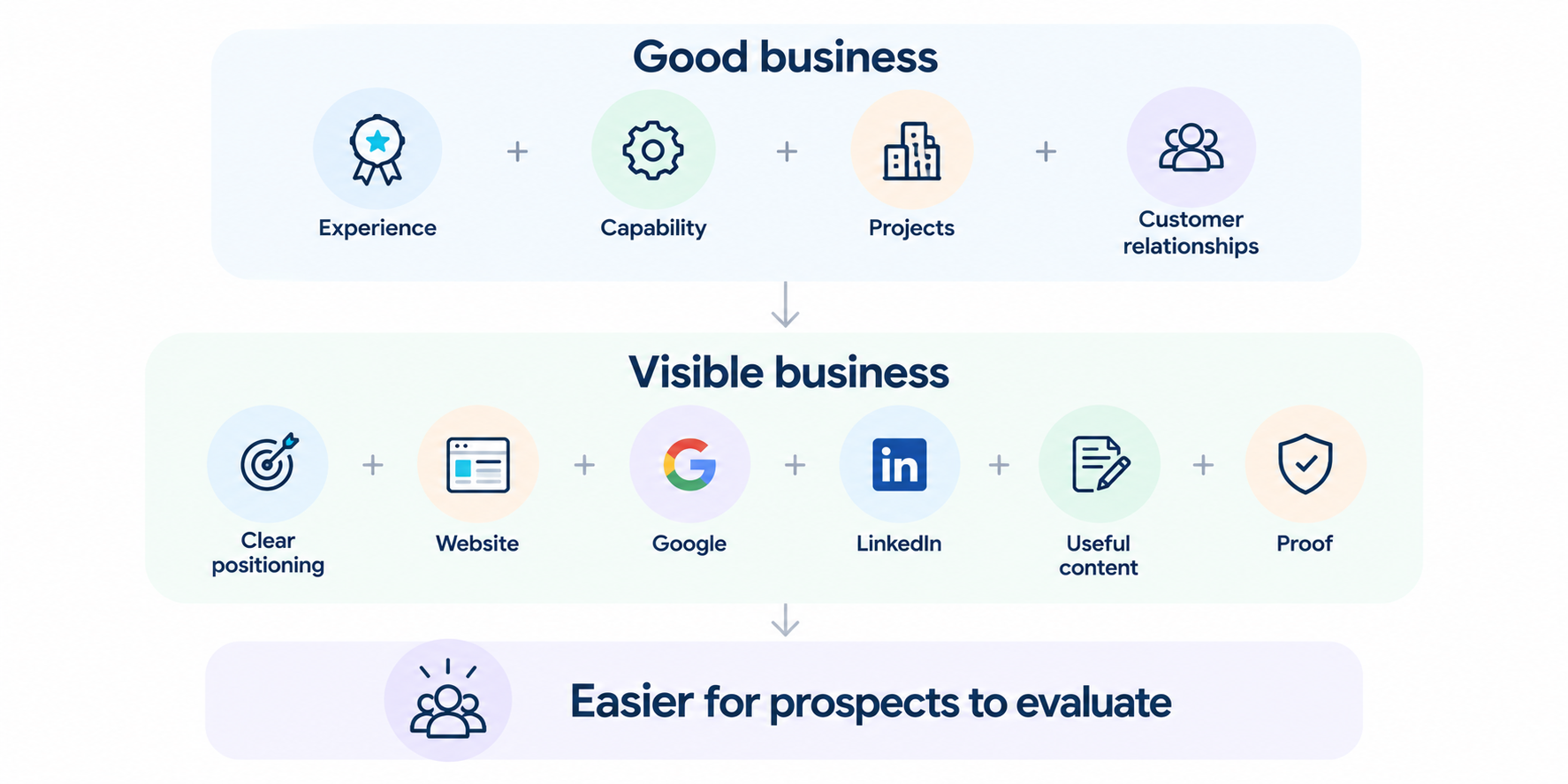
A scaffolding business does not necessarily need more marketing activity. It needs to be visible in the places where its potential customers are making decisions.
Consider a builder looking for a scaffolding provider.
They might search Google, ask someone in their network, look at a company’s website, check LinkedIn or investigate a business after receiving a recommendation.
At each point, they are trying to answer relatively simple questions:
What does this business do?
Can they handle the type of work I need?
Do they have relevant experience?
Can I trust them?
How do I contact them?
If the answers are difficult to find, the business may lose an opportunity before a conversation even begins.
This is why marketing for a scaffolding business should be considered as part of the customer journey rather than as a collection of disconnected activities.
A scaffolding business can offer much more than the equipment it supplies. Experience, technical knowledge, project planning, responsiveness, safety, capacity and the ability to work effectively with other trades can all contribute to the value a customer receives. The challenge is making those strengths visible and relevant to the people who are considering your business.
This is where positioning becomes important. Rather than simply describing what your business does, your marketing should help potential customers understand why your experience and capabilities matter to their projects. A builder looking for scaffolding is not only looking for equipment. They are looking for a provider they can rely on to meet the requirements of the project and work effectively within the wider construction process.
The strongest differentiators should come from the business itself. They should be based on real experience, customer feedback, project outcomes and capabilities rather than claims created simply because they sound good in marketing.
A useful way to clarify this value is to ask:
| Question | What it helps clarify |
| Who do we want more work from? | The customers who are most valuable to the business |
| What type of projects do we want? | The work where our capabilities are most relevant |
| What do those customers value from a scaffolding provider? | The priorities that should shape our message |
| What can we demonstrate from our own experience? | Evidence that supports our claims |
| Why do existing customers choose us? | The strengths that genuinely differentiate the business |
| What should someone understand before contacting us? | The message that helps prospects recognise our value |
The objective is not to convince everyone that your business is the best. It is to make your relevant strengths clear to the customers you want to work with, so they can understand the value you bring and have a stronger reason to start a conversation.
Scaffolding businesses have an advantage that many other industries do not: their work is highly visual.
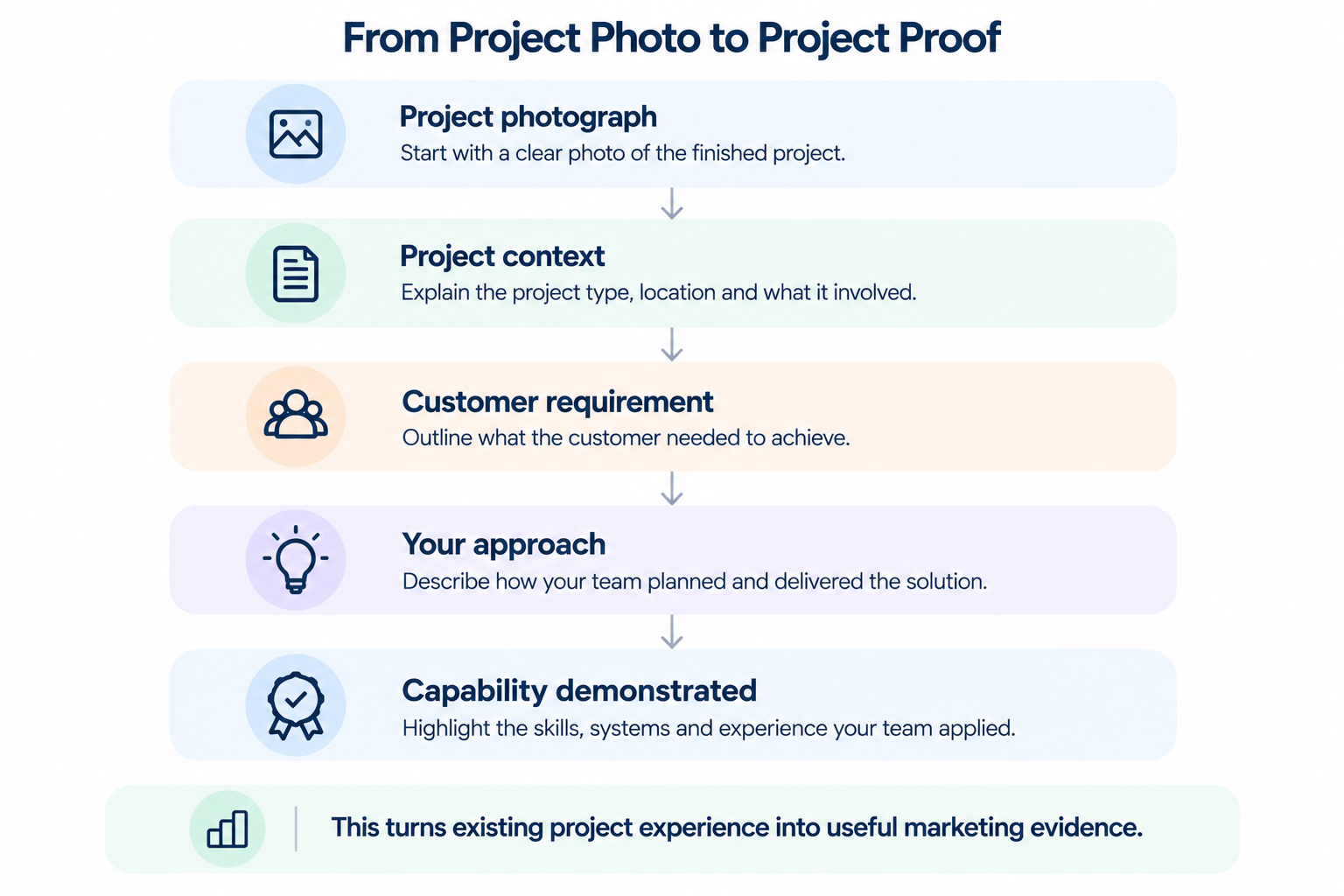
The challenge is that a photograph on its own often tells the audience very little.
A useful project post can explain what the project involved, what the customer needed, what the team had to consider and what the completed work demonstrates about the business.
For example: Commercial refurbishment project
The project required scaffold access across multiple work areas while other trades continued working on site. The team coordinated installation around the construction sequence to maintain access as the project progressed.
This provides context and demonstrates capability without making exaggerated claims.
The same principle applies to your website.
A project portfolio should not simply be a collection of photographs. Where appropriate, it can explain the type of project, scope, requirements and the role your business played.
A professional website is only useful if potential customers can find it and understand what they see once they arrive.
For a scaffolding business, that means clearly communicating the services offered, areas served and types of customers or projects supported. Service pages should use language that reflects how potential customers actually search and should provide enough useful information to help them assess whether the business is relevant.
Google’s guidance also emphasises making business information understandable to search engines and users. For eligible businesses, structured data can provide Google with information such as business name, address, telephone number and other details that can support how the business is represented in Search.
Local visibility is particularly relevant when scaffolding services are tied to specific geographic markets.
However, SEO should not become a project of inserting keywords into every page.
The objective is simpler:
Help the right customer find the right information at the right stage of their decision.
Google is useful when someone is actively looking.
LinkedIn can help you become visible before the customer is actively searching.
For a scaffolding business, this could mean building relationships with builders, construction managers, project managers, developers, contractors and other professionals who may influence future projects.
The value is not simply having more followers.
A network of relevant construction decision-makers is potentially much more useful than a large audience with little connection to the business you want to win.
Content then gives those people a reason to remember the company.
Project insights, answers to common questions, industry observations, team expertise and practical advice can demonstrate knowledge without turning every post into a sales pitch.
This is where LinkedIn becomes part of social selling rather than simply social media.
Marketing is not only about digital channels.
A potential customer may encounter your business through a website, LinkedIn, Google, an email, a capability statement or a recommendation from another contractor.
These touchpoints should feel like they belong to the same business.
If the website looks outdated but the LinkedIn profile is professional, or the company describes itself differently across different channels, the customer has to work harder to understand who they are dealing with.
Consistency does not mean making everything identical.
It means maintaining a clear presentation of:
This becomes particularly important when competing for larger or more structured projects, where the marketing materials may be part of how a potential customer evaluates the business before making contact.
Posting content, improving a website and building a LinkedIn network are useful activities, but they should ultimately connect to the customer journey.
A practical process might look like this:
Be Found. Use the website, Google and relevant channels to make the business discoverable.
Be Understood. Clearly explain services, project experience, capabilities and the types of customers you support.
Build Trust. Use project examples, expertise, customer feedback and professional presentation as evidence.
Start Conversations. Use LinkedIn, enquiries, website forms and other channels to create opportunities for direct contact.
Follow Up. Make sure enquiries and promising conversations are responded to and tracked.
Develop Opportunities. Move suitable prospects into the quoting and sales process.
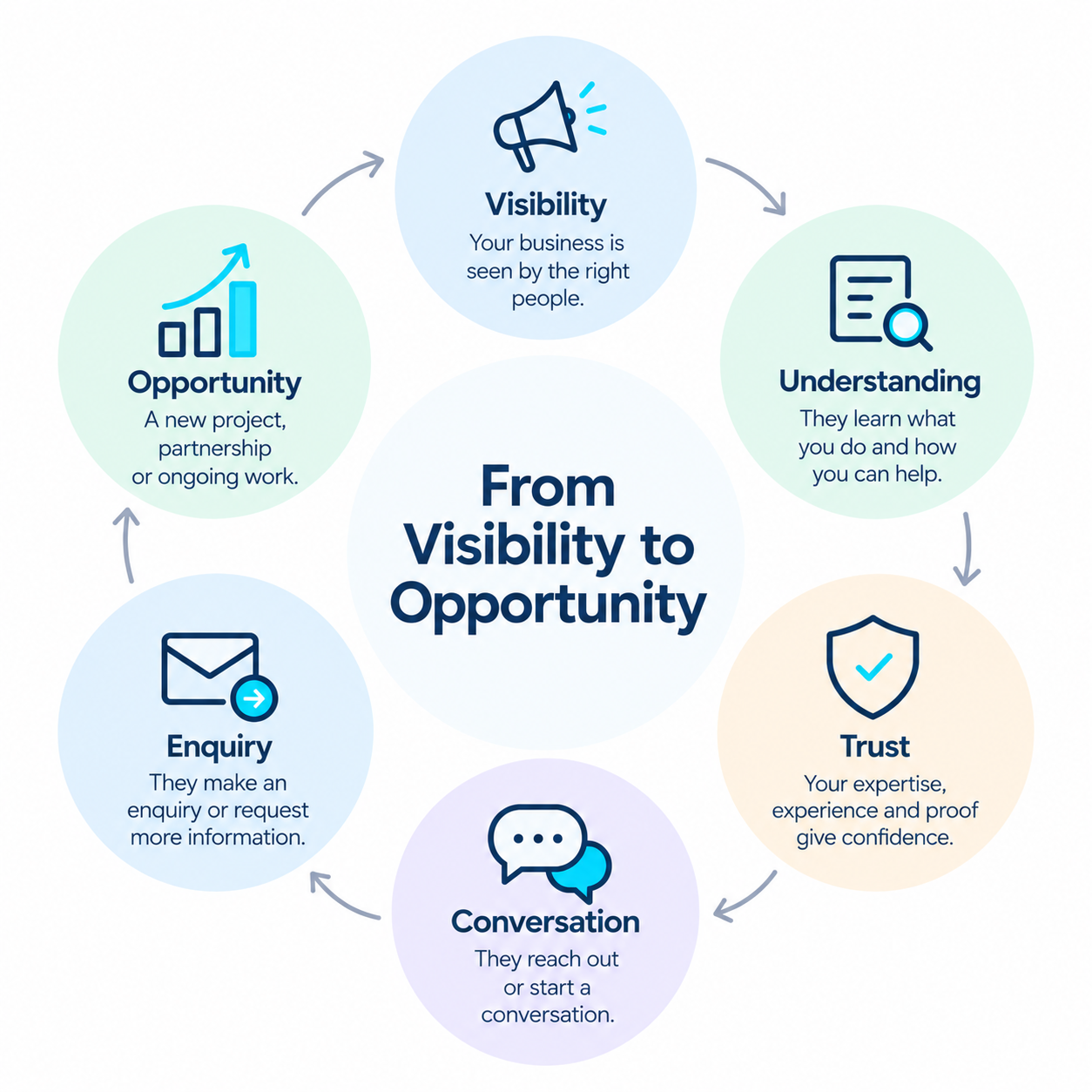
The important point is that marketing does not replace sales.
It helps create the conditions for better sales conversations.
A marketing plan can look very active without producing meaningful progress.
Ten social media posts, a growing follower count and a new website may all represent work, but they do not necessarily indicate that the business is becoming more commercially visible.
The more useful measures follow the journey towards business development.
| Stage | What to look at |
| Visibility | Relevant website traffic, search visibility and profile views |
| Audience | Relevant construction contacts and decision-makers |
| Engagement | Meaningful interactions from potential customers |
| Conversations | Direct conversations and enquiries |
| Opportunities | Meetings, quotation requests and active prospects |
| Business outcome | New relationships, accounts and won work |
The distinction matters because marketing should support the business rather than become an activity that exists for its own sake.
A competitor with more followers is not necessarily winning more work.
A competitor with fewer followers but stronger relationships with the right builders may be in a much better commercial position.
For many small and medium-sized scaffolding companies, the challenge is not understanding that marketing matters.
It is finding the time and expertise to do it consistently.
Running projects, managing crews, maintaining equipment, preparing quotes and looking after customers already fill the working week. Marketing often becomes something to handle when everything else is finished.
That can lead to a familiar cycle: marketing starts when work is quiet, stops when projects become busy, and starts again when the pipeline needs attention.
A more sustainable approach is to establish a clear system around the business’s actual goals.
That might mean improving the website before investing in advertising, strengthening the owner’s LinkedIn profile before starting outreach, creating a bank of project content rather than trying to think of a post every week, or putting a simple process in place for tracking enquiries.
The right priorities depend on the business.
The important thing is to fix the areas that are limiting visibility or conversion before simply adding more activity.
You do not need to launch every marketing channel at once.
Start by understanding where the biggest gap exists.
If potential customers struggle to find you, look at website and search visibility.
If they find you but cannot quickly understand your capabilities, look at positioning and website content.
If your business relies heavily on referrals but you want to build new professional relationships, look at LinkedIn and social selling.
If people are making enquiries but opportunities are being lost during follow-up, look at lead management and the sales process.
And if all of these areas are working but the business lacks consistency, the priority may be a clearer growth strategy.
The first step is not necessarily to spend more on marketing.
It is to understand what is already working and where the business is losing opportunities.
Peak Profile works with businesses to improve visibility, credibility, customer communication and business-development opportunities through practical marketing strategy and execution.
For a scaffolding business, that can mean looking at how the website, LinkedIn presence, content, positioning and lead-generation activities work together rather than treating each channel as a separate project.
The Peak Scorecard can provide a useful starting point for reviewing the current marketing presence and identifying areas that may need attention.
If you would like to discuss what those opportunities could mean for your business, contact Peak Profile.
A discovery call is an opportunity to discuss your current marketing, the type of work you want to win and where you believe the biggest opportunities may be.
There is no need to arrive with a complete marketing plan. The conversation can start with where the business is today and what you want to achieve next.
Marketing is not a substitute for quality scaffolding work, experience or strong customer relationships. Its role is to help potential customers discover the business, understand its capabilities and have enough confidence to start a conversation. The amount and type of marketing required will depend on the company’s goals, market and existing sources of work.
There is no single channel that is right for every scaffolding business. Website and Google visibility can help people who are actively looking, while LinkedIn can support professional networking and social selling. Content, project examples and consistent presentation can then reinforce credibility across these channels.
If the business wants to build relationships with builders, contractors, developers or other construction professionals, LinkedIn can be a useful channel. The objective should be to build a relevant professional network and create conversations rather than simply accumulate followers.
The website should clearly explain the services offered, areas served and types of projects or customers supported. Project examples, relevant experience, team information, safety or compliance information where appropriate, contact details and clear calls to action can help potential customers assess whether the business is suitable.
Start with a focused system rather than trying to manage every channel. Define the customers and work you want, improve the areas that currently limit visibility, create reusable content from real projects and experience, and establish a consistent process for networking, enquiries and follow-up. External support can then be used where the business lacks the time or specialist capability internally.
Peak Profile is a Sydney-based digital marketing agency. The team works across social selling, LinkedIn lead generation, content, SEO, paid advertising, email marketing and broader marketing strategy, connecting marketing activity with meaningful business objectives.

 Social Selling & Lead Generation
 Growth Strategy & Peak Scorecard
 Paid Growth & Search Advertising
 Content Marketing
  Email Marketing & Automation
 Search & AI Visibility