September 25 2026
You invested in a website because you wanted customers to find your business.
The design looks professional. Your services are listed. The business is established and customers are happy with the work you provide.
But when someone searches for the services you offer, competitors appear first.
Now another layer has been added to the problem. Customers are no longer researching businesses only through traditional Google results. They may ask Google AI Mode, ChatGPT, Microsoft Copilot or another AI-powered service to explain a problem, compare options or recommend what they should consider.
For businesses, that changes the visibility challenge.
It is no longer enough for a website simply to exist, and the goal should not be reduced to “ranking number one for a keyword”. Your website needs to make it easy for search engines, AI systems and, most importantly, potential customers to understand what you do, who you help, what expertise you have and why your information can be trusted.
The good news is that SEO and AI visibility do not require two completely separate marketing strategies.
The same strong foundations support both.
Google’s current guidance is explicit on this point: foundational SEO practices remain relevant to generative AI search. Helpful original content, technical accessibility, clear structure and a strong page experience continue to matter whether somebody discovers you through a traditional result or an AI-generated answer.
The objective is therefore straightforward:
Make your business easier to find, easier to understand and easier to trust wherever customers are researching their next decision.
Find out where your website and wider digital presence may be losing visibility and what should be prioritised first.
One of the most frustrating situations for a business owner is having a website that appears perfectly reasonable to a human visitor but remains difficult to discover through search.
That happens because a website has two jobs.
It needs to communicate effectively with the person who reaches it, but it also needs enough clarity and technical accessibility for search systems to understand what each page is about and when it may be relevant.
For example, imagine an accounting firm whose homepage says:
“Helping businesses achieve their potential through tailored solutions.”
It sounds professional.
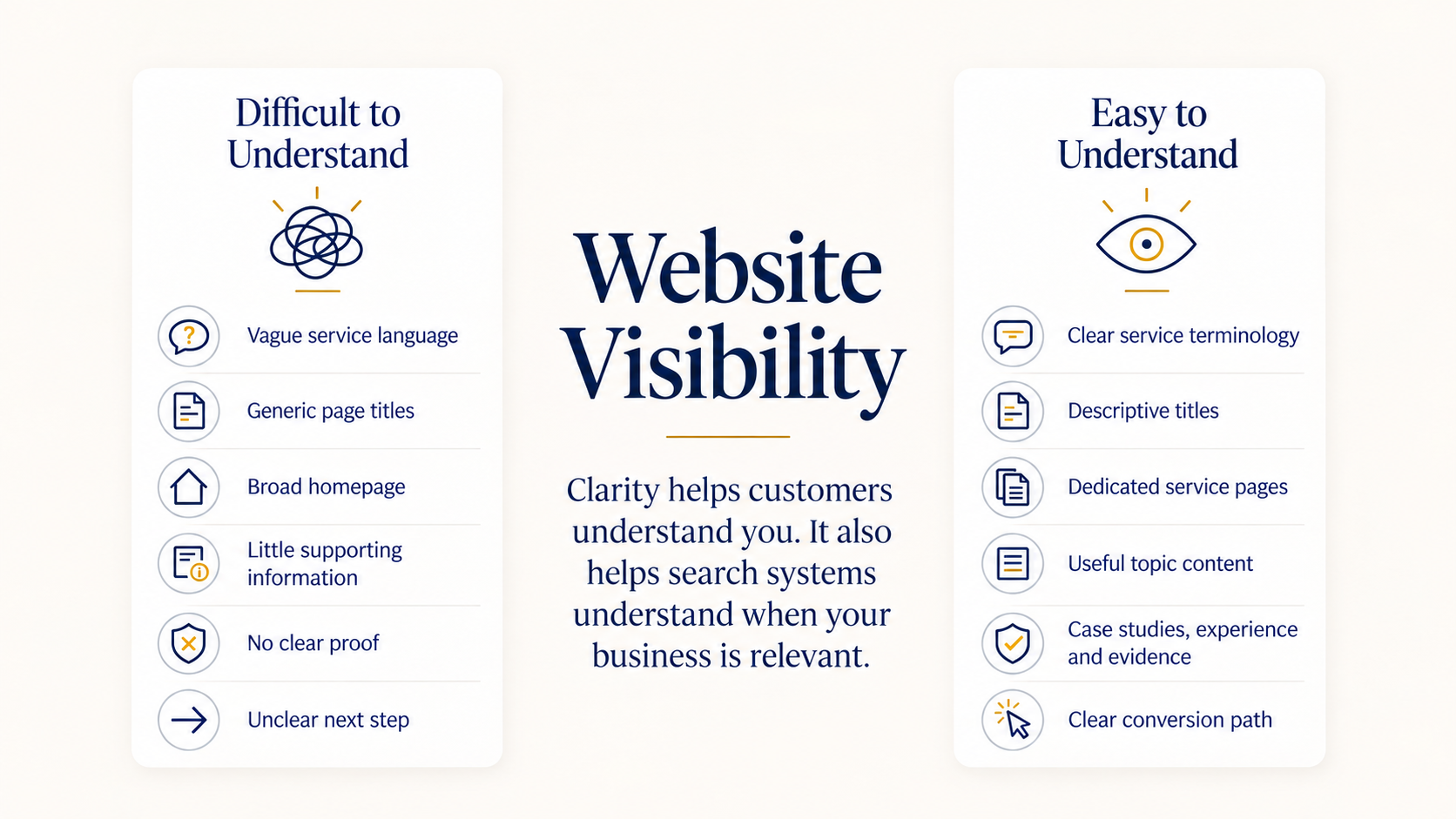
But it does not clearly tell a customer or search system whether the firm provides business accounting, tax advice, bookkeeping, SMSF services, CFO support or something entirely different.
A more descriptive website creates stronger signals through its page titles, headings, service copy, location information, internal links and supporting content.
Google’s Search Essentials recommends using the words people actually use when looking for your information and placing those words naturally in prominent areas such as page titles, headings, link text and image descriptions.
If your customers call the service one thing, but your website describes it using vague corporate language, you may be making discovery unnecessarily difficult.
Traditional SEO has usually focused on earning visibility within a list of search results.
AI-powered search changes the presentation.
Instead of simply presenting ten links, an AI system may research several sources, combine the information and give the user a direct answer.
That has led to terms such as Answer Engine Optimisation (AEO) and Generative Engine Optimisation (GEO).
AEO generally describes the work involved in making your information more likely to appear, be referenced or contribute to an AI-generated answer.
For Google specifically, however, this distinction is smaller than some marketing commentary suggests.
Google’s July 2026 guidance states that its AI Overviews and AI Mode use core Search systems to retrieve relevant information. Google also says that, from its perspective, optimisation for generative AI search is still optimisation for the wider search experience and therefore remains fundamentally connected to SEO.
Outside Google, AI citation visibility is also becoming measurable. Microsoft introduced an AI Performance report in Bing Webmaster Tools in February 2026, showing publishers when their pages are cited across Copilot, Bing AI-generated summaries and selected partner integrations.
For businesses, this creates two related visibility objectives:
| Traditional search visibility | AI-answer visibility |
|---|---|
| Appear for relevant searches | Become a useful source for relevant answers |
| Earn rankings and clicks | Earn mentions, citations and recommendations |
| Optimise pages around search intent | Provide clear, trustworthy information around questions |
| Measure rankings and organic traffic | Also monitor AI citations and AI-assisted discovery |
| Build topical authority | Build recognisable expertise and original evidence |
AEO should therefore not replace SEO.
It expands the definition of what being discoverable means.
Whenever search changes, new shortcuts quickly appear.
Special files.
Special formatting.
AI-only pages.
New forms of schema.
Hundreds of pages designed for tiny variations of the same question.
Google’s current guidance specifically warns businesses not to overcomplicate this area. It states that llms.txt is not required for Google’s generative search, that special AI schema is unnecessary and that pages do not need to be artificially broken into tiny “chunks” for Google’s systems to understand them.
The better approach is less exciting but considerably more useful.
Fix the fundamentals.
Technical accessibility
Search engines need to be able to crawl and index the pages you actually want customers to discover.
Issues involving indexing, robots directives, canonical URLs, duplicate pages, JavaScript rendering or broken site structures can prevent strong content from receiving the visibility it deserves.
Google confirms that a page must be indexed and eligible to appear in Search before it can be eligible for Google’s generative AI search features.
Page experience
A slow, confusing or difficult-to-use website creates problems after somebody arrives.
Mobile usability, loading performance, navigation and the ability to distinguish the main content all contribute to a stronger page experience. The original Peak Profile research also correctly identifies page speed, broken links and mobile optimisation as common areas businesses should review.
On-page clarity
Titles, headings, content structure, internal links, metadata and image descriptions should help explain what each page covers.
These are often among the most controllable SEO improvements a business can make because they sit directly on the website. That does not mean every change will immediately increase rankings, but correcting obvious on-page problems can create a much stronger foundation for everything that follows.
You do not need to write for robots.
You do need to make expertise easy to understand.
For both traditional search and AI-powered discovery, content should increasingly follow a few practical principles:
The important principle is that AEO does not mean shortening every page into a list of disconnected answers.
Google explicitly says there is no requirement to “chunk” content into tiny pieces or rewrite everything in a special AI format.
The article still needs to read naturally for a person.
A well-structured article serves several audiences at once.
A reader scanning the page can jump directly to the section they need.
A search engine can better understand the relationship between the main subject and supporting questions.
An AI-powered retrieval system has clearer context when identifying passages relevant to a question.
That is why useful long-form content often combines:
a descriptive H1, a short summary, explanatory paragraphs, clear H2 and H3 sections, tables where comparison helps, FAQs and an obvious next step.
This is also why every blog article should not be built around an arbitrary word count.
Google explicitly states that it does not have a preferred word count. The content should be as long as necessary to satisfy the reader without adding unnecessary material.
Social media does not automatically improve Google rankings simply because a post receives likes or shares.
Its value is more indirect.
A useful article can be distributed through LinkedIn, Facebook, Instagram, email or another appropriate channel. That distribution can introduce the content to journalists, customers, partners and other businesses that may later reference or link to it.
Social activity can also increase branded searches, website visits and familiarity with the business.
In the other direction, strong website content gives social media something more useful to distribute than another isolated post.
The Peak Profile research correctly sees these channels as complementary rather than entirely separate activities.
Businesses sometimes treat SEO and paid advertising as competing investments.
They are better understood as different ways of creating visibility.
Paid advertising can place a business in front of relevant audiences quickly while the budget is active. SEO generally takes longer because the business is building organic discoverability, useful content and authority over time.
The Peak Profile research correctly identifies the potential value of combining the two rather than forcing every company into an either/or decision.
For example, a business launching a new service may use Google Ads to capture active demand while simultaneously developing the service page and supporting SEO content required for longer-term organic discovery.
Paid advertising can address the immediate visibility problem.
SEO and AEO help build a stronger digital asset for the future.
A business can describe itself as an expert.
That becomes much stronger when other credible sources reinforce it.
Traditional SEO has long considered backlinks and wider authority, and your research identifies off-page optimisation as part of sustainable search visibility.
The same principle matters in a world of AI-assisted research.
AI systems may draw information from many sources, including websites, publications, reviews, industry discussions and other public material. This means the way a business is represented beyond its own site increasingly contributes to the overall picture available to potential customers.
For a real business, useful authority can come from genuine activities such as industry memberships, client reviews, partnerships, directories, media coverage, guest expertise, events and high-quality links from relevant organisations.
This should not become a campaign to manufacture hundreds of artificial mentions.
Google specifically warns against inauthentic mentions and link-related manipulation.
The goal is to build evidence that reflects the business’s actual credibility.
Rankings still matter.
Organic traffic still matters.
But neither should be evaluated without context.
A website can increase traffic substantially while attracting visitors who are unlikely to become customers. Another page may have lower search volume but consistently attract people with much stronger commercial intent.
AI-assisted search adds another set of visibility signals.
| Stage | Useful indicators |
|---|---|
| Technical health | Indexed pages, crawl issues, page experience |
| Search visibility | Relevant keyword rankings, impressions, search visibility |
| Organic engagement | Clicks, landing-page activity, content engagement |
| Authority | Relevant backlinks, brand mentions, reviews |
| AI visibility | AI citations, cited URLs, brand mentions in relevant answers |
| Conversion | Enquiries, bookings, downloads, calls |
| Lead quality | Qualified enquiries and sales opportunities |
| Business outcome | Customers, pipeline and revenue where measurable |
Google added a Generative AI performance report to Search Console in 2026 for monitoring discovery through its generative Search features, while Microsoft’s Bing Webmaster Tools now exposes citation data across supported AI experiences.
These tools make AI visibility easier to observe.
But a citation is not the final business goal.
The stronger question is still:
“Are we becoming easier for the right customers to discover, trust and choose?”
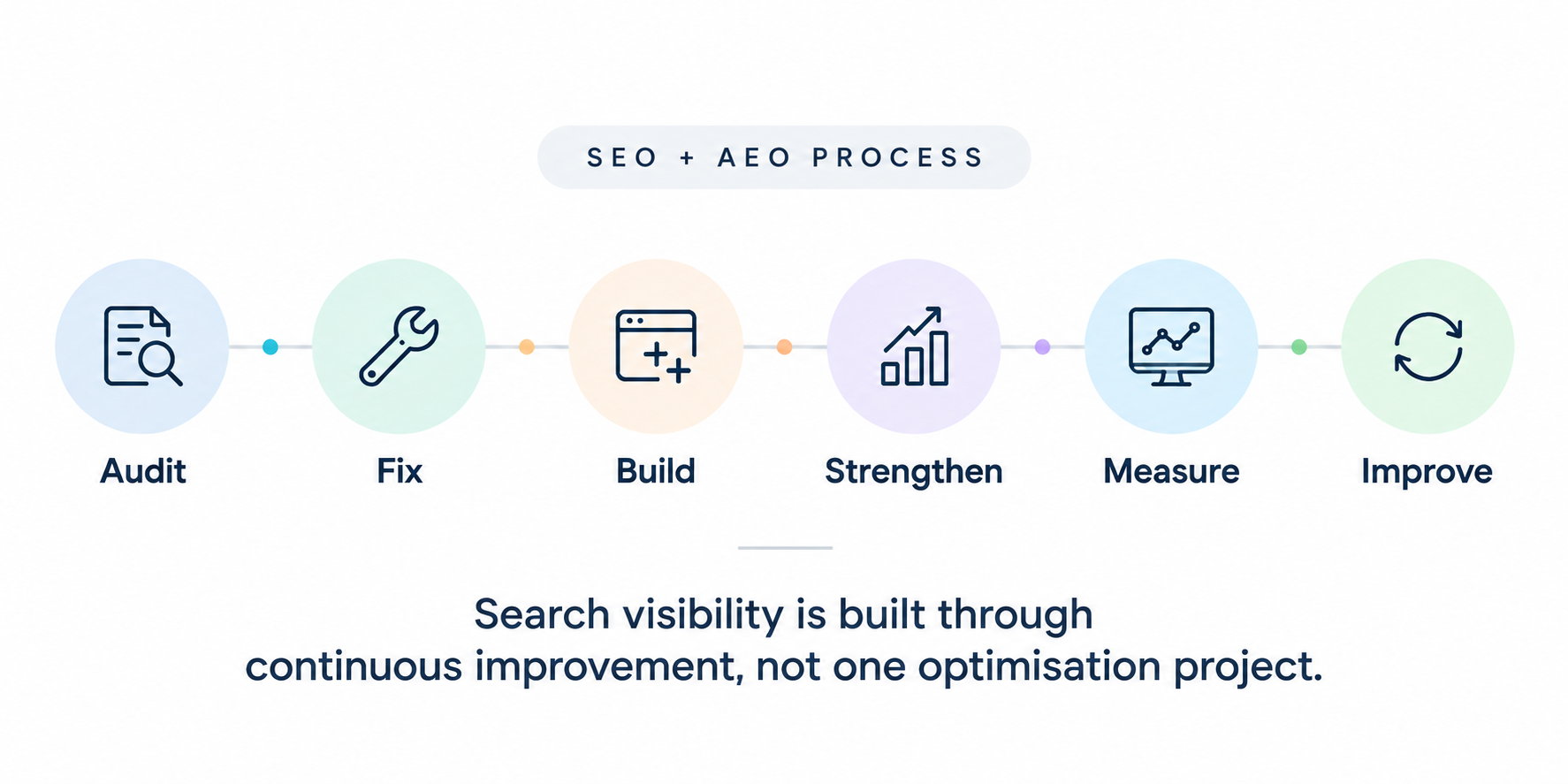
SEO works better when it is treated as an ongoing improvement process rather than a one-off website task.
For Peak Profile, that process can be expressed clearly as:
Audit identifies where visibility is being lost across technical SEO, content, search intent, positioning, authority and conversion paths.
Fix addresses high-priority technical and on-page problems that may be limiting discovery or usability.
Build develops stronger service pages, useful content and answers around the questions customers actually ask.
Strengthen connects the website with internal links, social distribution, credible external mentions and supporting proof.
Measure looks at rankings, traffic, conversions and emerging AI visibility rather than relying on one headline metric.
Improve uses the evidence to update pages, expand useful topics and remove friction from the customer journey.
Your website may already have many of the right ingredients.
The problem might be one technical issue preventing an important page from being indexed.
It might be unclear service positioning.
It might be generic content that does not demonstrate enough expertise.
Your strongest pages may need updating.
Your website and social content may not be connected.
Or your business may be visible in traditional search but still poorly represented within emerging AI research journeys.
Publishing more content before identifying the issue may simply create more work.
A better first step is understanding where the gaps are.
Peak Profile’s broader marketing audit can assess how your website fits into the wider digital visibility and customer journey, including:
SEO and technical visibility, website positioning, service-page clarity, content quality, search intent, internal linking, social-media integration, conversion paths, authority opportunities and emerging AI-search visibility.
The goal is to identify what is already working, where potential customers may be losing the path to your business and which improvements deserve attention first.
Find out where your digital presence may be losing search visibility, customer attention or opportunities.
There may be several reasons, including indexing or technical issues, poor alignment with search intent, weak or duplicate content, limited authority, unclear page structure or strong competition. An audit is usually the best starting point because improving the wrong issue can create more work without solving the actual visibility problem.
SEO traditionally focuses on improving visibility in search-engine results. AEO, or Answer Engine Optimisation, generally refers to improving the likelihood that a business or its information appears in AI-generated answers. The disciplines overlap significantly. Google itself says that, for its generative AI Search features, established SEO fundamentals remain the foundation.
Usually not. Google specifically says websites do not need to rewrite content solely for generative AI systems. The stronger approach is to produce useful, original, well-structured information for people and make sure that information can be crawled and understood.
Only when the new content genuinely adds value. Publishing large volumes of generic articles simply to target more keywords is not a strong long-term approach. Google recommends original, helpful, people-first content that demonstrates real expertise rather than material created primarily to attract search traffic.
Yes, when there is something meaningful to improve. Older pages can benefit from updated information, better explanations, new examples, stronger internal linking and improved visuals. Simply changing the publication date without materially improving the content is not useful.
Social activity is not a direct guarantee of higher search rankings, but it can support distribution, brand awareness, website visits and opportunities for useful content to earn links or mentions. Strong website and social content can therefore reinforce each other as parts of the broader marketing system.
There is no universal timeline. Results depend on the site’s starting position, technical condition, competition, market, existing authority and the scale of improvements required. Some technical or on-page changes may produce signals relatively quickly, while building substantial authority and competitive organic visibility usually takes longer.

 Social Media Management
 Social Media Strategy Planning
 Social Media Setup & Branding
 Content Creation & Publishing
 Email Marketing
 Search Engine Optimization (SEO)
 Pay-per-click (PPC) Advertising