October 16 2026

If you are considering B2B social selling for your business, one of the first questions is likely to be: how long will it take to produce results?
It is a reasonable question. Business owners and managers invest time and money because they want to create opportunities, generate leads and ultimately win more business. If your team is already busy with customers, operations and sales, spending time building a LinkedIn network needs to have a clear purpose.
The difficulty is that social selling does not normally work like an advertisement. An advertising campaign can put an offer in front of someone and potentially generate an immediate response. Social selling starts by putting your business in front of the right people, building familiarity, demonstrating expertise and developing professional relationships. The commercial result can therefore take longer to develop.
That does not mean nothing is happening while you wait for a lead. A relevant person discovering your profile, accepting a connection, engaging with your content or starting a conversation can all represent progress.
The better question is therefore not simply “How many weeks until I get a lead?” It is “What should be happening at each stage, and when should those activities begin contributing to business opportunities?”
B2B social selling is often misunderstood as sending LinkedIn messages to potential customers.
Messages are only one part of the process.
At its core, social selling is about using professional networks to identify relevant people, establish familiarity, demonstrate expertise and create opportunities for meaningful conversations.
This makes it different from a traditional direct sales approach.
A prospect may first encounter your business through a LinkedIn post. They might then look at your profile, connect with you, see another piece of content and eventually respond to a message. By the time a sales conversation takes place, they may already have some understanding of who you are and what your business does.
That process can be particularly relevant in industries with longer buying cycles.
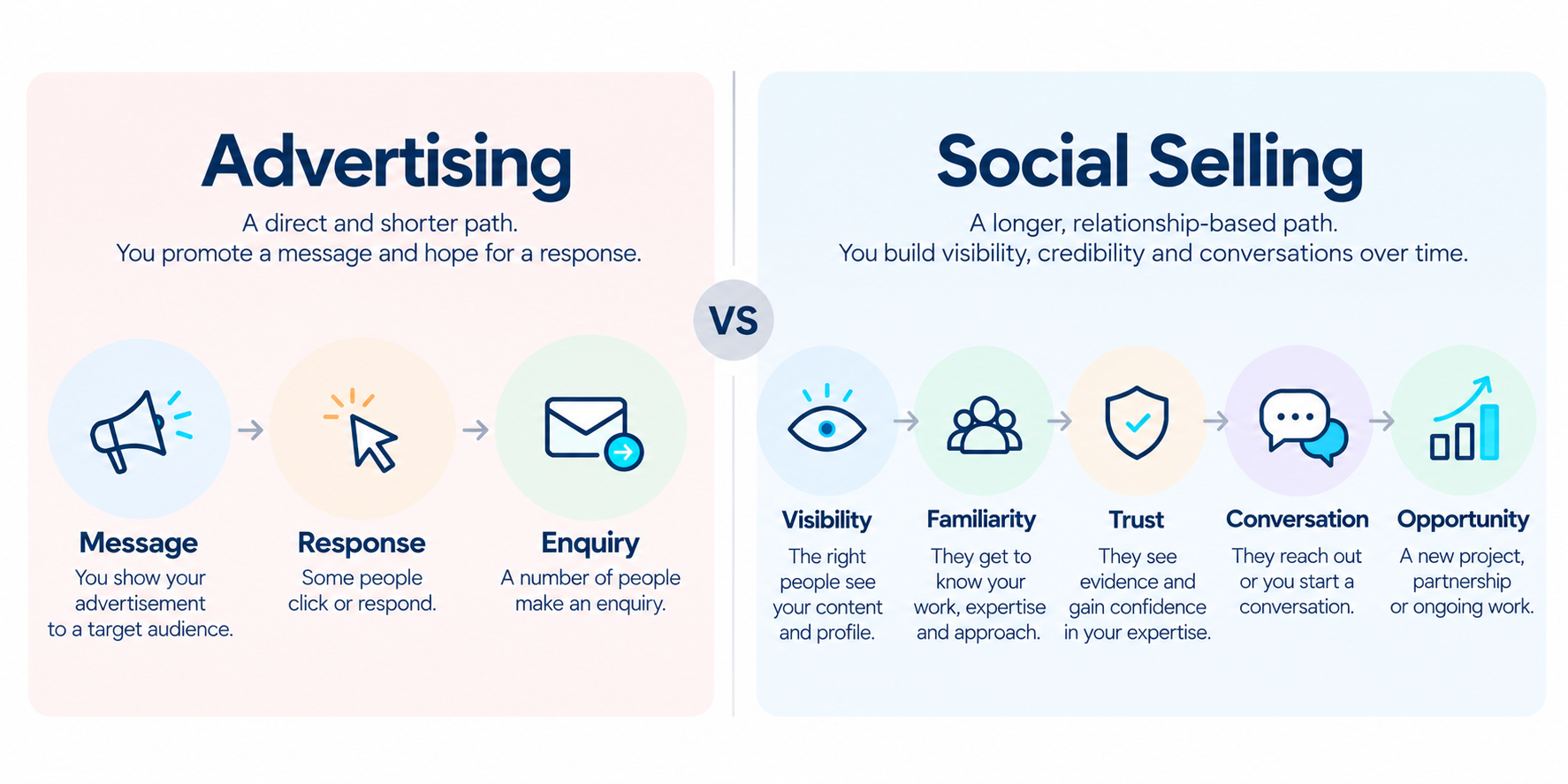
At Peak Profile, we approach B2B social selling as a relationship-building process rather than a sequence of promotional messages. It starts with a credible profile and the right network, then builds familiarity through useful content, strategic engagement and relevant outreach. The goal is to develop those relationships into meaningful conversations and, ultimately, potential business opportunities.
There is no universal timeframe.
The speed at which social selling produces commercial results depends on factors such as your starting network, target market, offer, existing reputation, content, outreach quality, consistency and the length of your sales cycle.
The first few months should not be judged solely by whether a major deal has been won. Instead, look for evidence that the quality of your network and conversations is improving.
A business that already has an established network of relevant decision-makers may generate conversations relatively quickly. A company starting with a limited LinkedIn presence may first need to build credibility and establish the right connections.
It is therefore more useful to think about social selling in stages of progress rather than a single deadline.
| Stage | What you are building | What to look for |
| Visibility | Awareness | Relevant people discovering your business |
| Network | Reach | Connections with target decision-makers |
| Engagement | Familiarity | Meaningful interactions with relevant people |
| Conversation | Relationships | Direct conversations with prospects |
| Opportunity | Commercial interest | Meetings, enquiries and quotation discussions |
| Pipeline | Business development | Active opportunities and potential new accounts |
This provides a more realistic way to assess progress.
If a business has moved from almost no relevant LinkedIn relationships to a network of potential customers who recognise the company and are willing to communicate with it, something valuable has already happened.
The next question is whether those relationships are progressing towards commercial opportunities.
One of the easiest ways to slow down social selling is to build the wrong network.
A large number of connections is not necessarily useful if those people have little relevance to your business.
The audience should be defined by the type of customers and opportunities you want to develop.
Depending on the business, that might include:
The exact audience will vary.
A software company may target technology leaders. An accounting firm may focus on business owners and finance decision-makers. A construction business may target builders, developers, project managers and procurement professionals.
A prospect who receives a connection request may investigate your profile before deciding whether to engage further.
What they find can either reinforce the reason for connecting or create uncertainty.
Your profile should make it relatively easy to understand:
The company page should provide additional evidence and context.
This does not mean turning LinkedIn into a sales brochure. It means making sure that when someone takes the time to investigate your business, the information they find supports the relationship you are trying to build.
For an owner-led business, the personal profile can be particularly important because the relationship is being built between people, while the company page reinforces the organisation behind that person.
A prospect does not necessarily need your service when they first discover you. That is why useful content has a role beyond generating likes or comments.
Content can demonstrate how you think, what you know and the problems you understand. The subject matter should come from the questions your customers actually ask and the situations they encounter.
For example:
A construction business could explain what builders should consider before engaging a scaffolding provider.
An accounting firm could explain common financial issues business owners need to consider before expanding.
A software company could explain how to evaluate whether an integration project is worth pursuing.
The common principle is simple: Show your expertise in a way that helps the people you want to work with.
A project photograph, customer question, industry observation or practical explanation can all contribute to that process when the content provides context and demonstrates genuine knowledge.
Publishing content is only one part of social selling.
If your target customers are active on LinkedIn, paying attention to their activity can create additional opportunities to become familiar with them.
That might mean contributing to a relevant discussion, responding to a post or acknowledging something connected to their business.
The objective is not to comment on everything or manufacture engagement.
It is to participate where there is a genuine reason to contribute.
Over time, these small interactions can make a future direct conversation feel more natural because the prospect is no longer encountering your business for the first time.
After several months of consistent activity, you should ideally be able to see whether the strategy is creating a stronger foundation for business development.
That might include a more relevant professional network, greater visibility among target decision-makers, more meaningful engagement and an increasing number of direct conversations.
For some businesses, this can lead to meetings and enquiries relatively quickly. For others, the sales cycle may mean that opportunities take longer to develop.
A professional services firm may spend months developing a relationship before a client is ready to engage. A construction company may connect with a project manager well before a relevant project reaches procurement. A technology provider may need several conversations before a prospect is ready to evaluate a solution.
This is why a three-to-six-month period should be viewed as a useful evaluation window, not a guarantee that every business will generate a particular number of leads.
The question should be whether the quality and commercial relevance of the relationships are improving.
One of the reasons businesses invest in social selling is that the work can continue to provide value beyond the first interaction. This is different from an advertising campaign where the visibility generally depends on continuing to spend.
That does not make social selling “free”. It requires strategy, content, research, outreach, engagement and follow-up.
But the objective is to build an asset of relevant relationships and professional visibility, rather than relying only on individual campaigns.
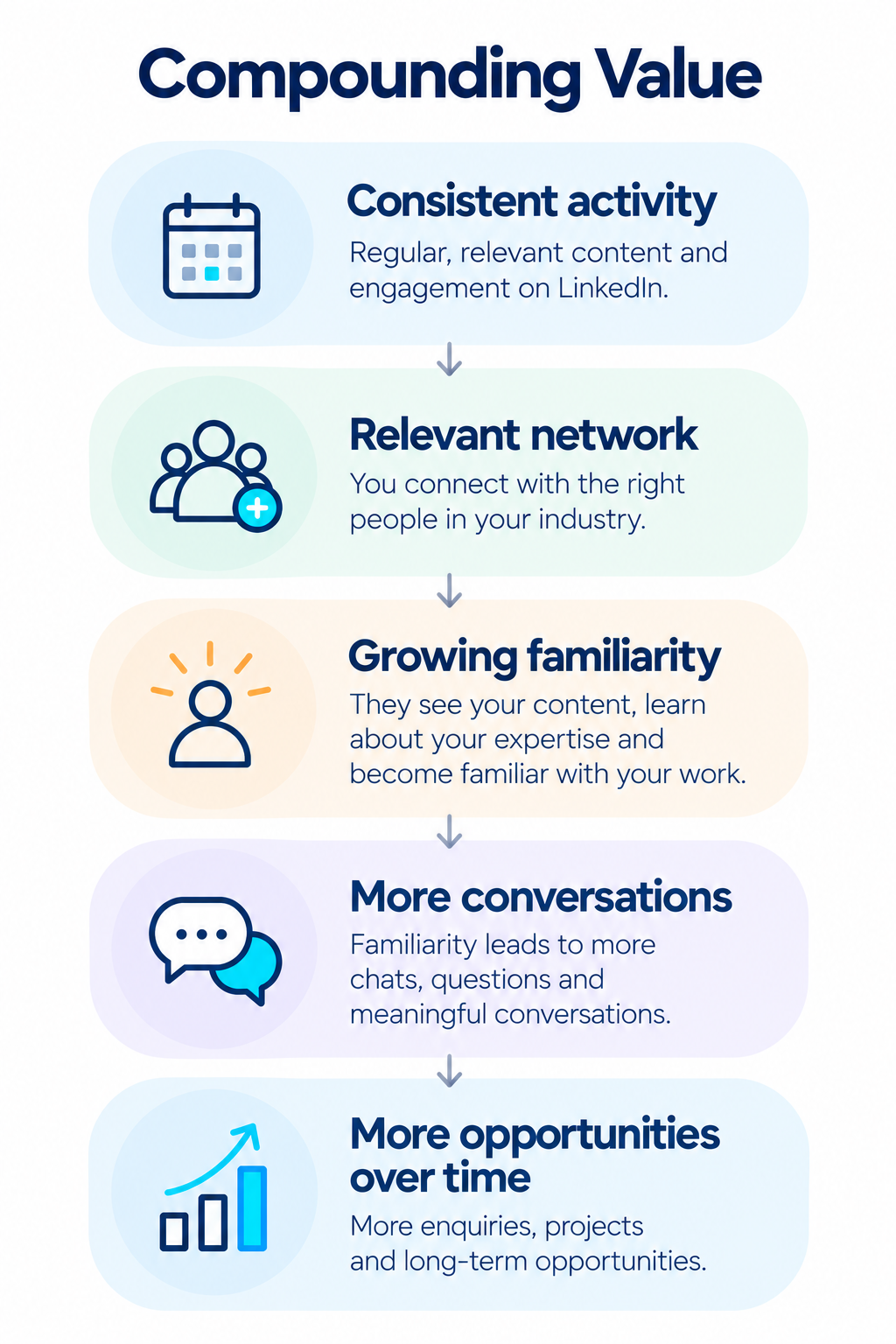
Follower growth and post reach can provide useful context, but they should not be the primary measure of a B2B social-selling programme.
The more useful measures follow the journey towards commercial results.
| Area | What to measure |
| Network | Relevant decision-makers added |
| Visibility | Profile views and relevant content reach |
| Engagement | Meaningful interactions from target prospects |
| Conversations | Direct conversations started |
| Leads | Qualified prospects and enquiries |
| Opportunities | Meetings, quotations and active opportunities |
| Commercial outcome | New accounts and won business |
The distinction is important because social selling starts producing signals before it produces sales.
A growing number of relevant connections and conversations can indicate that the strategy is moving in the right direction. If months pass without meaningful engagement from the intended audience, however, the answer may not simply be to wait longer.
The strategy may need to change.
A prospect might discover your business today, connect next week, engage with your content several times and contact you six months later.
Another prospect might respond to an outreach message immediately.
Someone else may remain connected for two years before becoming a customer.
All three relationships can be valuable.
This is why social selling should be understood as a process of moving relevant people from unknown to known, from known to familiar, and from familiar to a potential business relationship.
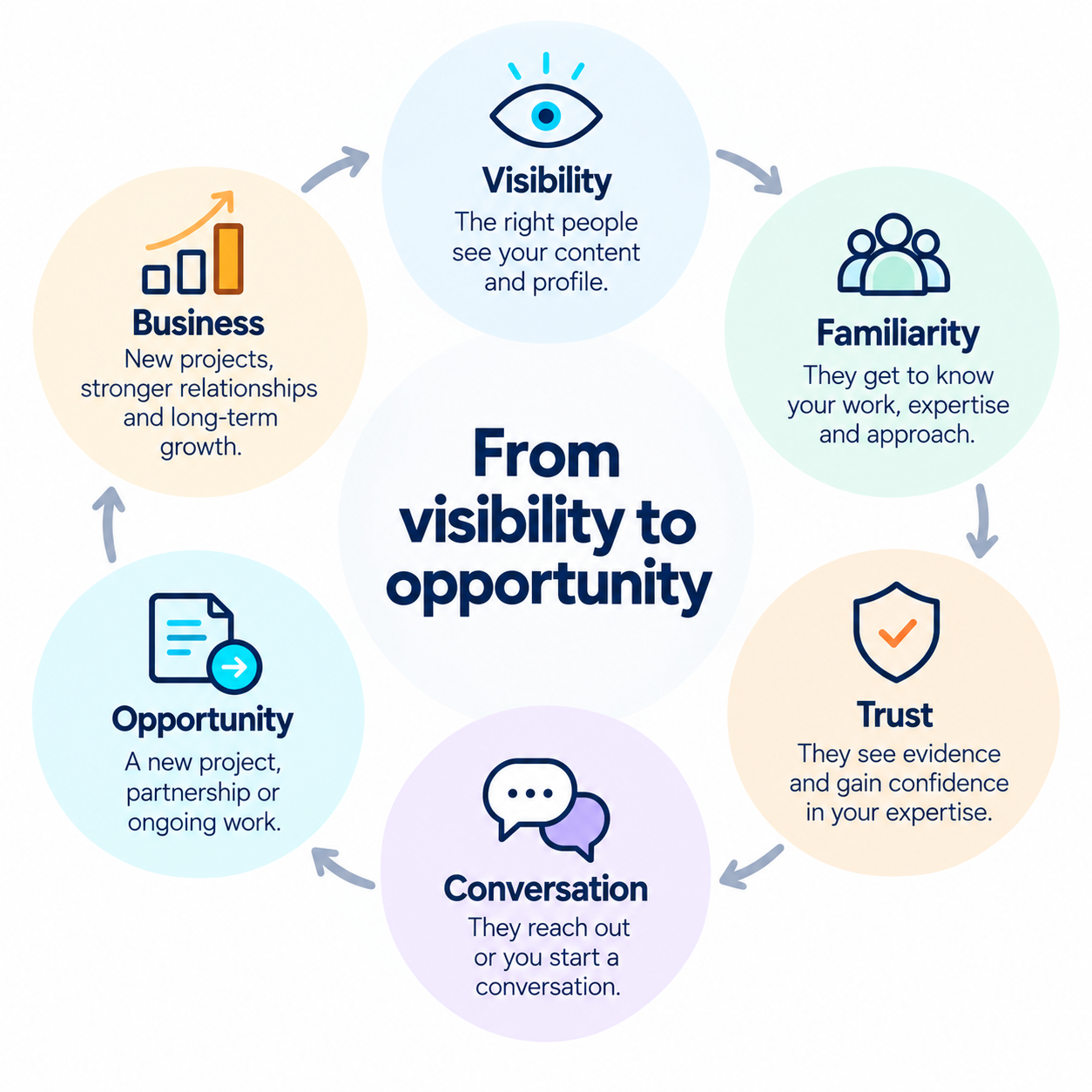
The timeframe will vary.
The progression is what matters.
For businesses that rely heavily on referrals, existing relationships or reactive sales activity, social selling can provide another way to build a future pipeline.
It can be particularly valuable when your potential customers are identifiable professional decision-makers and the buying process depends on trust and relationships.
It is not a replacement for a strong service, a clear offer or an effective sales process.
Nor should it be treated as a shortcut to instant leads.
Its value comes from consistently building visibility and relationships with the people your business actually wants to work with.
If those relationships are developing into relevant conversations and opportunities, social selling is doing its job.
For businesses without an internal marketing team, managing audience research, LinkedIn activity, content, outreach and follow-up alongside day-to-day operations can be difficult.
Peak Profile’s Social Selling & Lead Generation service is designed to bring these activities together around a clear business-development objective.
The approach starts with identifying the right audience and strengthening the business’s professional presence. From there, targeted network building, useful content, engagement, relevant outreach and follow-up work together to create opportunities for meaningful conversations.
The objective is not simply to make a business more active on LinkedIn.
It is to help create a repeatable process for building relevant relationships that can contribute to the sales pipeline.
If you are considering social selling but are not sure whether it fits your business, a discovery call can be a useful starting point.
Discuss your current lead sources, target customers, LinkedIn presence and business-development goals with the Peak Profile team.
There is no fixed timeframe. Some businesses may generate conversations relatively quickly, while others need several months to build the right network and develop relationships. The target audience, sales cycle, existing network, content and outreach approach all influence the timeframe.
It can produce early signals such as relevant connections, profile views, engagement and conversations. However, these should not be confused with guaranteed sales results. The first month is often more useful for establishing the foundations and testing whether the business is reaching the right people.
Give the strategy enough time to build a meaningful network and generate a pattern of interactions rather than judging it after a few posts. A review after the first few months can help determine whether the right audience is being reached and whether activity is progressing towards relevant conversations and opportunities.
Not necessarily. It is most useful where potential customers can be identified through professional roles, companies or industries and where relationships influence purchasing decisions. The suitability depends on the target market and sales model rather than simply whether the business operates in B2B.
No. Targeted outreach can be part of social selling, but it is combined with profile optimisation, content, engagement and relationship-building. The objective is to make outreach more relevant and create a context for conversations rather than relying entirely on cold sales messages.
Measure relevant connections, engagement from target prospects, conversations, qualified leads, meetings, quotations and opportunities. These provide a clearer picture of commercial progress than follower numbers or post volume alone.
Neither is universally better. Paid advertising can create faster visibility and immediate response opportunities, while social selling focuses on developing professional relationships over time. Many B2B businesses can use both, depending on their objectives, audience and sales cycle.
Peak Profile is a Sydney-based digital marketing agency. The team works across social selling, LinkedIn lead generation, content, SEO, paid advertising, email marketing and broader marketing strategy, connecting marketing activity with meaningful business objectives.
October 2 2026

A scaffolding business can have years of experience, a capable team, substantial equipment and a strong project history, yet still be difficult for potential customers to understand online.
On LinkedIn, this often shows up as a feed full of scaffolding photographs, equipment, completed projects and company updates. These posts demonstrate that the business is active, but they do not always explain what makes the company worth contacting.
For small and medium-sized scaffolding businesses, the issue is therefore not simply having a social media presence. If LinkedIn does not communicate capability, experience and the type of work the business wants to win, it becomes another place to display equipment rather than a channel that supports business development.
The opportunity is to use LinkedIn to do more than showcase the business. Used strategically, it can help a scaffolding company become visible to relevant construction professionals, demonstrate its expertise, build relationships and create conversations that may develop into commercial opportunities.
Scaffolding equipment is an important part of the service, but it is rarely the only consideration when a builder, contractor or project team chooses a provider.
They may also want to understand whether the business can handle the requirements of the project, work within the required timeframe, communicate effectively, manage changes and demonstrate the experience and safety standards expected on site.
This is why the strongest scaffolding marketing goes beyond equipment.
A photograph shows the scaffold. A project story shows what your business can do.
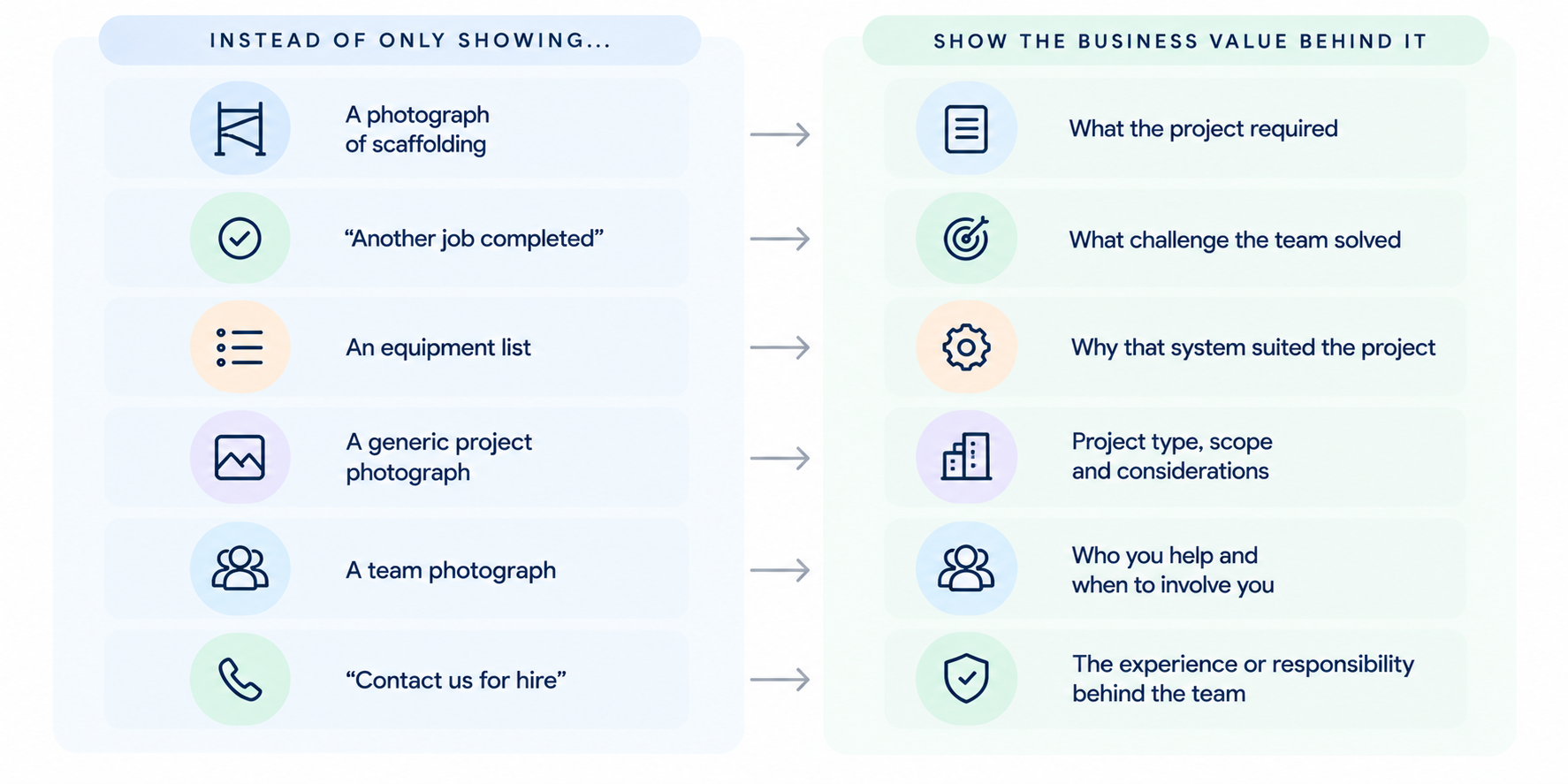
The aim is not to make every post longer. It is to give the right people a reason to remember the business.
LinkedIn lead generation becomes difficult when the target audience is simply described as “people in construction”.
The right audience depends on the work the business wants to win. A company focused on commercial construction may need relationships with builders, construction managers, project managers and procurement professionals. A business targeting residential builders will need a different network, while an industrial or infrastructure specialist may need to focus on a much narrower group of organisations and roles.
Before creating content or sending connection requests, define the commercial objective.
Ask: Which professional relationships could lead to the type of work we actually want?
That question is more useful than asking how many LinkedIn connections the business should have.
Once a potential customer receives a connection request, one of the first things they may do is look at the person’s LinkedIn profile.
That profile should quickly explain what the business does, where it operates, what types of projects it supports and what experience it brings.
The same applies to the company page.
The goal is not to turn either profile into a sales brochure. It is to make sure that when someone investigates the business, the information they find reinforces the credibility established through the connection or conversation.
This is particularly important when the owner or manager is responsible for business development. Their personal profile can communicate experience and industry knowledge, while the company page provides additional information about the organisation.
Scaffolding businesses already have a valuable source of content ideas: the questions customers ask.
A builder may want to know when a scaffolding provider should become involved, what information is needed for a quote, what can affect project requirements or how changes to the construction schedule may affect the scaffolding arrangement.
These questions create much stronger content opportunities than simply finding another photograph to publish.
For example, instead of posting: “Another commercial project completed.”
a business could explain what the project required, what the team needed to consider and what other builders could learn from the experience.
Industry research highlights that scaffolding businesses face a range of operational challenges beyond equipment itself, including design and planning, bidding, managing project changes, maintaining clear client communication and managing inventory efficiently. These areas can have a direct impact on how a scaffolding business delivers projects and supports its customers, making them useful topics for demonstrating industry expertise through content.
Your own experience with these types of challenges can become useful educational content.
Project content is particularly valuable because it can provide evidence rather than simply making claims.
A useful project post can answer four questions:
What was the project?
Explain the type of construction or work.
What did the customer need?
Describe the access, timing, complexity or other relevant requirement.
What did your team do?
Explain the approach without revealing confidential information.
What did the project demonstrate?
Connect the experience to a capability another potential customer may need.
For example:
Commercial refurbishment
The project required scaffold access across multiple work areas while other trades continued operating on site. The team coordinated installation around the construction sequence to maintain access as the project progressed.
This provides considerably more commercial value than simply saying “another project completed”.
The photograph is still useful. The context is what makes it meaningful.
Content alone does not create a lead-generation strategy.
A scaffolding business can publish useful posts every week and still fail to reach the people it wants to work with if there is no deliberate approach to building the right network.
Social selling connects the two.
The process can be kept simple:
1. Identify – Find companies and decision-makers that match the type of work you want.
2. Research – Understand their role, projects and relevance before contacting them.
3. Connect – Send a professional connection request without immediately turning it into a sales pitch.
4. Demonstrate – Use useful content and project insights to show what the business knows.
5. Engage – Participate in relevant conversations and respond to people who interact with your content.
6. Start a conversation – When there is a relevant reason, move from LinkedIn interaction to a direct conversation.
7. Follow up – Keep track of promising relationships so they do not disappear after the first interaction.
The objective is not to pressure someone into a meeting. It is to create enough relevance and familiarity for a professional conversation to develop.
Peak Profile’s approach similarly combines audience research, LinkedIn strategy, prospect targeting, connection building, outreach, follow-up, profile optimisation, engagement and lead tracking, with the emphasis on relevant prospects and business conversations rather than follower numbers.
A useful content mix should demonstrate different aspects of the business rather than repeatedly promoting the same service.
| Content | What it demonstrates | Example |
| Projects | Experience | What the team solved on a complex project |
| Expertise | Knowledge | What builders should consider before engaging a provider |
| Safety | Professional standards | How the business approaches safe access |
| Planning | Project understanding | How scaffolding requirements affect project sequencing |
| People | Experience and trust | Team expertise and responsibilities |
| Equipment | Capability | Why a particular system suited the project |
| Industry insights | Market understanding | An issue affecting construction |
| Customer questions | Understanding | Answers to common project questions |
| Achievements | Proof | Relevant milestones or completed work |
The important point is that equipment becomes evidence of capability rather than the entire content strategy.
Generating an enquiry is not the same as generating a business opportunity.
Someone may send a LinkedIn message, complete a contact form or ask for more information. If the enquiry is not responded to, recorded, qualified and followed up, some of the value created by the marketing activity can be lost.
This is especially relevant to smaller scaffolding businesses where the owner or manager may already be responsible for operations, quoting, customer relationships and marketing.
A simple process should establish:
This is the point where LinkedIn becomes part of a business-development process rather than simply another social media channel.
Follower numbers and post counts can tell you whether activity is happening, but they do not tell you whether LinkedIn is supporting business development.
A better measurement framework follows the customer journey.
| Stage | Useful measures |
| Visibility | Relevant profile views and reach |
| Network | Relevant decision-maker connections |
| Engagement | Meaningful interactions from target professionals |
| Conversations | Direct conversations started |
| Leads | Qualified enquiries and prospects |
| Opportunities | Meetings, quotations and active opportunities |
| Business outcome | New accounts, relationships and won work |
The distinction is important because LinkedIn activity does not automatically translate into business results. Publishing ten posts may keep the business visible, but connecting with relevant construction decision-makers represents progress towards building the right network. A qualified enquiry is a stronger indicator that the marketing is creating commercial interest, while developing an ongoing relationship with a potential builder can create opportunities beyond a single enquiry. Ultimately, the measure of success is whether these activities contribute to meaningful business outcomes, such as new accounts, projects and won work.
LinkedIn does not need to replace referrals, repeat customers, Google or existing industry relationships.
Each channel can play a different role.
Someone may find the business through Google, then check its LinkedIn profile before making contact. An existing customer may recommend the company, while LinkedIn content reinforces its expertise. A construction manager may discover the business through a relevant connection before there is an immediate need for scaffolding.
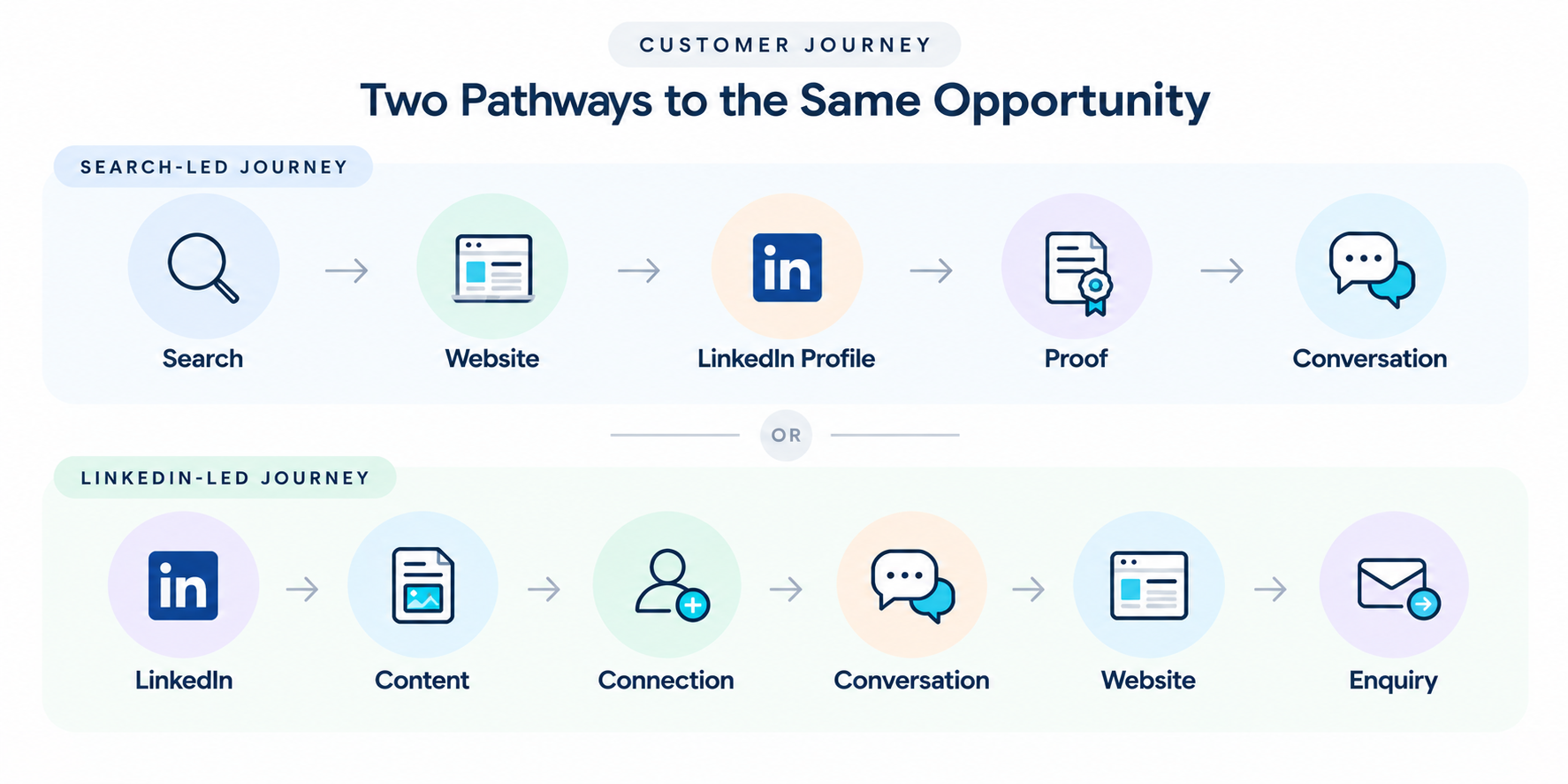
The important thing is that the business is credible and easy to understand wherever the potential customer encounters it.
For a small or medium-sized scaffolding business without a dedicated marketing department, the process needs to be manageable.
A practical system can be built around six stages:
1. Define the work you want more of
Identify the types of projects, customers and geographic areas that matter commercially.
2. Build a focused prospect list
Identify relevant companies and decision-makers rather than collecting contacts without a clear purpose.
3. Strengthen the LinkedIn presence
Make sure the personal and company profiles communicate capability and credibility.
4. Create useful content
Answer customer questions and use projects, expertise and industry knowledge to demonstrate capability.
5. Combine content with outreach
Use content to create familiarity while targeted networking creates opportunities for conversation.
6. Track and follow up
Make sure relevant conversations and enquiries move into a defined sales process.
This creates a repeatable system without requiring the business owner to become a full-time content creator or LinkedIn specialist.
If most of your work currently comes from referrals, repeat builders and existing relationships, LinkedIn does not need to replace those sources.
The more useful question is whether there are relevant construction businesses and decision-makers you are currently not reaching.
If there are, LinkedIn can provide another way to build those relationships before a project reaches the quotation stage.
You do not need hundreds of posts or a large marketing department to start. The foundation is much simpler:
The right audience. A credible profile. Useful content. Relevant connections. Consistent follow-up.
Together, these elements can turn LinkedIn from a place where your business displays its work into a channel that supports business development.
For scaffolding businesses without an internal marketing team, managing audience research, content, LinkedIn networking and follow-up alongside daily operations can be difficult.
Peak Profile’s Social Selling & Lead Generation service brings these activities together around a defined business-development objective. The focus is on reaching relevant decision-makers, building professional relationships and creating conversations that can develop into qualified opportunities.
If you are unsure whether your current LinkedIn presence is supporting your business-development goals, contact Peak Profile to discuss your current approach.
If LinkedIn lead generation and social selling could support the type of work you want to win, a discovery call can provide an opportunity to discuss your target market, current lead sources and LinkedIn presence.
Yes. LinkedIn can support B2B lead generation when a scaffolding business uses targeted networking, useful content and follow-up together. It is particularly relevant when the target customers include builders, contractors, developers and other construction decision-makers.
Useful content can include project experience, customer questions, planning considerations, safety, technical expertise, team experience, equipment in context and relevant industry insights. The aim is to demonstrate what the business can do, not simply show what equipment it owns.
No. A sustainable publishing schedule is more useful than posting for the sake of activity. The priority should be relevant content that supports the business’s commercial objectives and professional relationships.
An owner’s or manager’s profile can be valuable for relationship-building because it allows the business to communicate expertise through a real professional voice. The company page can then provide additional organisational information and proof.
They serve different purposes. Google can capture people actively searching for scaffolding, while LinkedIn can help a business identify and build relationships with relevant decision-makers before they are actively looking for a provider. The two channels can work alongside each other.
Measure progress through relevant connections, engagement from target professionals, conversations, qualified enquiries, meetings, quotations and opportunities. Follower numbers and post volume are useful activity indicators, but they do not demonstrate commercial impact on their own.
There is no universal timeframe. Results depend on the target audience, existing network, content, outreach, consistency and follow-up. LinkedIn should be approached as a relationship-building channel rather than a source of guaranteed immediate enquiries.
Peak Profile is a Sydney-based digital marketing agency. The team works across social selling, LinkedIn lead generation, content, SEO, paid advertising, email marketing and broader marketing strategy, connecting marketing activity with meaningful business objectives.
September 25 2026

Being active on LinkedIn is not the same as building a strong LinkedIn presence.
A business owner can publish several times a week, connect with new people, react to posts and comment regularly without becoming meaningfully more visible to the people who could eventually become customers. Activity keeps the account moving, but activity alone does not necessarily create recognition, credibility or business opportunities.
The problem is usually not that the business needs to do more. It is that its LinkedIn activity does not reinforce a clear enough position for the right audience to understand what the business does, why its expertise matters and what it should be remembered for.
Organic LinkedIn growth works differently. It is built by combining clear positioning, a relevant network, useful content, consistent engagement and a recognisable point of view. Over time, those elements help people become familiar with the business before a direct sales conversation begins.
For most businesses, the objective should not be to become a LinkedIn influencer or build the largest possible following. It should be to become recognisable, credible and useful within the market the business wants to serve.
That is where organic LinkedIn starts contributing to growth.
| Question | What businesses should know |
|---|---|
| What is organic LinkedIn growth? | Building visibility, credibility, relationships and business opportunities through profiles, content, networking and engagement without relying on paid advertising. |
| Is follower growth the main goal? | No. Reaching relevant professionals and becoming recognisable within the right market is usually more valuable. |
| What drives sustainable growth? | Clear positioning, relevant networks, useful expertise-led content, consistent engagement and measurement. |
| Should businesses post every day? | Not necessarily. A sustainable publishing rhythm with useful content is more important than volume for its own sake. |
| Should the company page or personal profiles lead? | Often both. Company pages establish the organisational presence, while leaders and experts add human perspective and credibility. |
| Can LinkedIn support AI visibility? | Increasingly, yes. LinkedIn’s own 2026 research shows that public professional content is being used by AI-powered discovery tools and search experiences. |
| What should be measured? | Relevant reach, audience quality, profile activity, conversations, enquiries, opportunities and, where useful, AI citations and visibility. |
| Does LinkedIn replace sales? | No. It helps build familiarity and trust so direct business-development conversations can begin from a stronger position. |
Discover how businesses can build visibility, trust and new opportunities through organic LinkedIn growth.

 Social Selling & Lead Generation
 Growth Strategy & Peak Scorecard
 Paid Growth & Search Advertising
 Content Marketing
 Email Marketing & Automation
 Search & AI Visibility