October 2 2026
A scaffolding business can have years of experience, a capable team, substantial equipment and a strong project history, yet still be difficult for potential customers to understand online.
On LinkedIn, this often shows up as a feed full of scaffolding photographs, equipment, completed projects and company updates. These posts demonstrate that the business is active, but they do not always explain what makes the company worth contacting.
For small and medium-sized scaffolding businesses, the issue is therefore not simply having a social media presence. If LinkedIn does not communicate capability, experience and the type of work the business wants to win, it becomes another place to display equipment rather than a channel that supports business development.
The opportunity is to use LinkedIn to do more than showcase the business. Used strategically, it can help a scaffolding company become visible to relevant construction professionals, demonstrate its expertise, build relationships and create conversations that may develop into commercial opportunities.
Scaffolding equipment is an important part of the service, but it is rarely the only consideration when a builder, contractor or project team chooses a provider.
They may also want to understand whether the business can handle the requirements of the project, work within the required timeframe, communicate effectively, manage changes and demonstrate the experience and safety standards expected on site.
This is why the strongest scaffolding marketing goes beyond equipment.
A photograph shows the scaffold. A project story shows what your business can do.
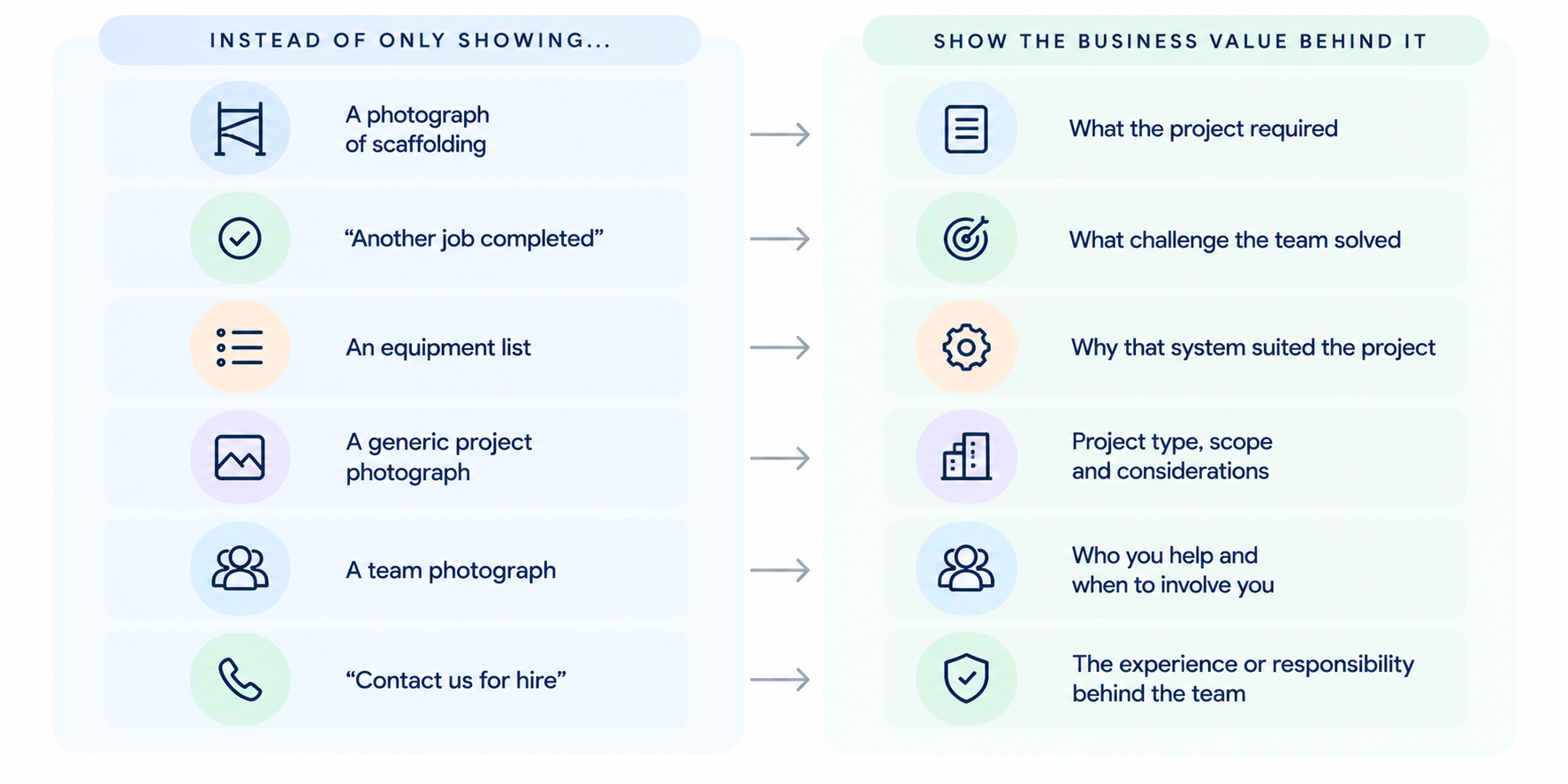
The aim is not to make every post longer. It is to give the right people a reason to remember the business.
LinkedIn lead generation becomes difficult when the target audience is simply described as “people in construction”.
The right audience depends on the work the business wants to win. A company focused on commercial construction may need relationships with builders, construction managers, project managers and procurement professionals. A business targeting residential builders will need a different network, while an industrial or infrastructure specialist may need to focus on a much narrower group of organisations and roles.
Before creating content or sending connection requests, define the commercial objective.
Ask: Which professional relationships could lead to the type of work we actually want?
That question is more useful than asking how many LinkedIn connections the business should have.
Once a potential customer receives a connection request, one of the first things they may do is look at the person’s LinkedIn profile.
That profile should quickly explain what the business does, where it operates, what types of projects it supports and what experience it brings.
The same applies to the company page.
The goal is not to turn either profile into a sales brochure. It is to make sure that when someone investigates the business, the information they find reinforces the credibility established through the connection or conversation.
This is particularly important when the owner or manager is responsible for business development. Their personal profile can communicate experience and industry knowledge, while the company page provides additional information about the organisation.
Scaffolding businesses already have a valuable source of content ideas: the questions customers ask.
A builder may want to know when a scaffolding provider should become involved, what information is needed for a quote, what can affect project requirements or how changes to the construction schedule may affect the scaffolding arrangement.
These questions create much stronger content opportunities than simply finding another photograph to publish.
For example, instead of posting: “Another commercial project completed.”
a business could explain what the project required, what the team needed to consider and what other builders could learn from the experience.
Industry research highlights that scaffolding businesses face a range of operational challenges beyond equipment itself, including design and planning, bidding, managing project changes, maintaining clear client communication and managing inventory efficiently. These areas can have a direct impact on how a scaffolding business delivers projects and supports its customers, making them useful topics for demonstrating industry expertise through content.
Your own experience with these types of challenges can become useful educational content.
Project content is particularly valuable because it can provide evidence rather than simply making claims.
A useful project post can answer four questions:
What was the project?
Explain the type of construction or work.
What did the customer need?
Describe the access, timing, complexity or other relevant requirement.
What did your team do?
Explain the approach without revealing confidential information.
What did the project demonstrate?
Connect the experience to a capability another potential customer may need.
For example:
Commercial refurbishment
The project required scaffold access across multiple work areas while other trades continued operating on site. The team coordinated installation around the construction sequence to maintain access as the project progressed.
This provides considerably more commercial value than simply saying “another project completed”.
The photograph is still useful. The context is what makes it meaningful.
Content alone does not create a lead-generation strategy.
A scaffolding business can publish useful posts every week and still fail to reach the people it wants to work with if there is no deliberate approach to building the right network.
Social selling connects the two.
The process can be kept simple:
1. Identify – Find companies and decision-makers that match the type of work you want.
2. Research – Understand their role, projects and relevance before contacting them.
3. Connect – Send a professional connection request without immediately turning it into a sales pitch.
4. Demonstrate – Use useful content and project insights to show what the business knows.
5. Engage – Participate in relevant conversations and respond to people who interact with your content.
6. Start a conversation – When there is a relevant reason, move from LinkedIn interaction to a direct conversation.
7. Follow up – Keep track of promising relationships so they do not disappear after the first interaction.
The objective is not to pressure someone into a meeting. It is to create enough relevance and familiarity for a professional conversation to develop.
Peak Profile’s approach similarly combines audience research, LinkedIn strategy, prospect targeting, connection building, outreach, follow-up, profile optimisation, engagement and lead tracking, with the emphasis on relevant prospects and business conversations rather than follower numbers.
A useful content mix should demonstrate different aspects of the business rather than repeatedly promoting the same service.
| Content | What it demonstrates | Example |
| Projects | Experience | What the team solved on a complex project |
| Expertise | Knowledge | What builders should consider before engaging a provider |
| Safety | Professional standards | How the business approaches safe access |
| Planning | Project understanding | How scaffolding requirements affect project sequencing |
| People | Experience and trust | Team expertise and responsibilities |
| Equipment | Capability | Why a particular system suited the project |
| Industry insights | Market understanding | An issue affecting construction |
| Customer questions | Understanding | Answers to common project questions |
| Achievements | Proof | Relevant milestones or completed work |
The important point is that equipment becomes evidence of capability rather than the entire content strategy.
Generating an enquiry is not the same as generating a business opportunity.
Someone may send a LinkedIn message, complete a contact form or ask for more information. If the enquiry is not responded to, recorded, qualified and followed up, some of the value created by the marketing activity can be lost.
This is especially relevant to smaller scaffolding businesses where the owner or manager may already be responsible for operations, quoting, customer relationships and marketing.
A simple process should establish:
This is the point where LinkedIn becomes part of a business-development process rather than simply another social media channel.
Follower numbers and post counts can tell you whether activity is happening, but they do not tell you whether LinkedIn is supporting business development.
A better measurement framework follows the customer journey.
| Stage | Useful measures |
| Visibility | Relevant profile views and reach |
| Network | Relevant decision-maker connections |
| Engagement | Meaningful interactions from target professionals |
| Conversations | Direct conversations started |
| Leads | Qualified enquiries and prospects |
| Opportunities | Meetings, quotations and active opportunities |
| Business outcome | New accounts, relationships and won work |
The distinction is important because LinkedIn activity does not automatically translate into business results. Publishing ten posts may keep the business visible, but connecting with relevant construction decision-makers represents progress towards building the right network. A qualified enquiry is a stronger indicator that the marketing is creating commercial interest, while developing an ongoing relationship with a potential builder can create opportunities beyond a single enquiry. Ultimately, the measure of success is whether these activities contribute to meaningful business outcomes, such as new accounts, projects and won work.
LinkedIn does not need to replace referrals, repeat customers, Google or existing industry relationships.
Each channel can play a different role.
Someone may find the business through Google, then check its LinkedIn profile before making contact. An existing customer may recommend the company, while LinkedIn content reinforces its expertise. A construction manager may discover the business through a relevant connection before there is an immediate need for scaffolding.
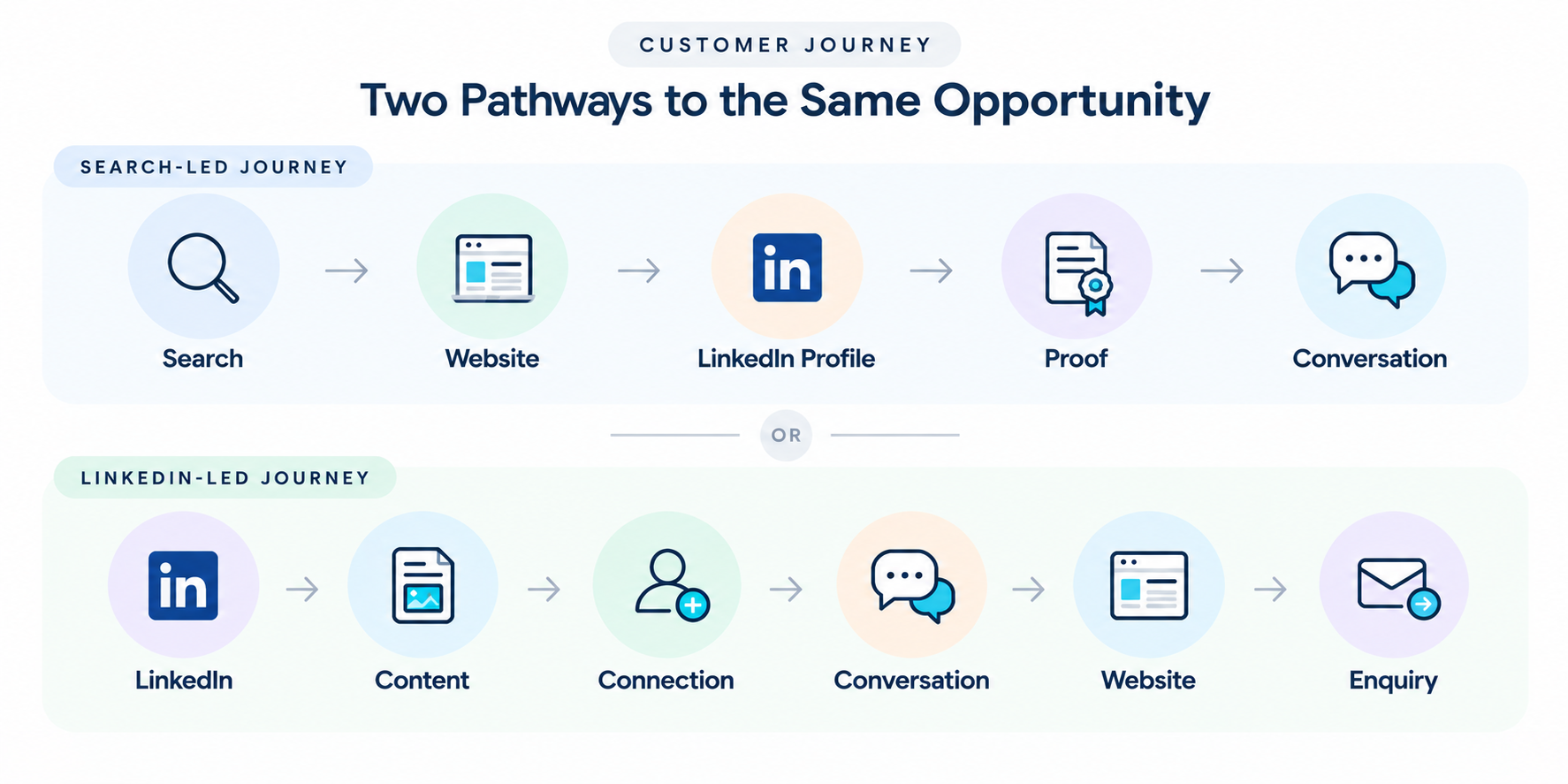
The important thing is that the business is credible and easy to understand wherever the potential customer encounters it.
For a small or medium-sized scaffolding business without a dedicated marketing department, the process needs to be manageable.
A practical system can be built around six stages:
1. Define the work you want more of
Identify the types of projects, customers and geographic areas that matter commercially.
2. Build a focused prospect list
Identify relevant companies and decision-makers rather than collecting contacts without a clear purpose.
3. Strengthen the LinkedIn presence
Make sure the personal and company profiles communicate capability and credibility.
4. Create useful content
Answer customer questions and use projects, expertise and industry knowledge to demonstrate capability.
5. Combine content with outreach
Use content to create familiarity while targeted networking creates opportunities for conversation.
6. Track and follow up
Make sure relevant conversations and enquiries move into a defined sales process.
This creates a repeatable system without requiring the business owner to become a full-time content creator or LinkedIn specialist.
If most of your work currently comes from referrals, repeat builders and existing relationships, LinkedIn does not need to replace those sources.
The more useful question is whether there are relevant construction businesses and decision-makers you are currently not reaching.
If there are, LinkedIn can provide another way to build those relationships before a project reaches the quotation stage.
You do not need hundreds of posts or a large marketing department to start. The foundation is much simpler:
The right audience. A credible profile. Useful content. Relevant connections. Consistent follow-up.
Together, these elements can turn LinkedIn from a place where your business displays its work into a channel that supports business development.
For scaffolding businesses without an internal marketing team, managing audience research, content, LinkedIn networking and follow-up alongside daily operations can be difficult.
Peak Profile’s Social Selling & Lead Generation service brings these activities together around a defined business-development objective. The focus is on reaching relevant decision-makers, building professional relationships and creating conversations that can develop into qualified opportunities.
If you are unsure whether your current LinkedIn presence is supporting your business-development goals, contact Peak Profile to discuss your current approach.
If LinkedIn lead generation and social selling could support the type of work you want to win, a discovery call can provide an opportunity to discuss your target market, current lead sources and LinkedIn presence.
Yes. LinkedIn can support B2B lead generation when a scaffolding business uses targeted networking, useful content and follow-up together. It is particularly relevant when the target customers include builders, contractors, developers and other construction decision-makers.
Useful content can include project experience, customer questions, planning considerations, safety, technical expertise, team experience, equipment in context and relevant industry insights. The aim is to demonstrate what the business can do, not simply show what equipment it owns.
No. A sustainable publishing schedule is more useful than posting for the sake of activity. The priority should be relevant content that supports the business’s commercial objectives and professional relationships.
An owner’s or manager’s profile can be valuable for relationship-building because it allows the business to communicate expertise through a real professional voice. The company page can then provide additional organisational information and proof.
They serve different purposes. Google can capture people actively searching for scaffolding, while LinkedIn can help a business identify and build relationships with relevant decision-makers before they are actively looking for a provider. The two channels can work alongside each other.
Measure progress through relevant connections, engagement from target professionals, conversations, qualified enquiries, meetings, quotations and opportunities. Follower numbers and post volume are useful activity indicators, but they do not demonstrate commercial impact on their own.
There is no universal timeframe. Results depend on the target audience, existing network, content, outreach, consistency and follow-up. LinkedIn should be approached as a relationship-building channel rather than a source of guaranteed immediate enquiries.
Peak Profile is a Sydney-based digital marketing agency. The team works across social selling, LinkedIn lead generation, content, SEO, paid advertising, email marketing and broader marketing strategy, connecting marketing activity with meaningful business objectives.

 Social Selling & Lead Generation
 Growth Strategy & Peak Scorecard
 Paid Growth & Search Advertising
 Content Marketing
  Email Marketing & Automation
 Search & AI Visibility