October 16 2026

If you are considering B2B social selling for your business, one of the first questions is likely to be: how long will it take to produce results?
It is a reasonable question. Business owners and managers invest time and money because they want to create opportunities, generate leads and ultimately win more business. If your team is already busy with customers, operations and sales, spending time building a LinkedIn network needs to have a clear purpose.
The difficulty is that social selling does not normally work like an advertisement. An advertising campaign can put an offer in front of someone and potentially generate an immediate response. Social selling starts by putting your business in front of the right people, building familiarity, demonstrating expertise and developing professional relationships. The commercial result can therefore take longer to develop.
That does not mean nothing is happening while you wait for a lead. A relevant person discovering your profile, accepting a connection, engaging with your content or starting a conversation can all represent progress.
The better question is therefore not simply “How many weeks until I get a lead?” It is “What should be happening at each stage, and when should those activities begin contributing to business opportunities?”
B2B social selling is often misunderstood as sending LinkedIn messages to potential customers.
Messages are only one part of the process.
At its core, social selling is about using professional networks to identify relevant people, establish familiarity, demonstrate expertise and create opportunities for meaningful conversations.
This makes it different from a traditional direct sales approach.
A prospect may first encounter your business through a LinkedIn post. They might then look at your profile, connect with you, see another piece of content and eventually respond to a message. By the time a sales conversation takes place, they may already have some understanding of who you are and what your business does.
That process can be particularly relevant in industries with longer buying cycles.
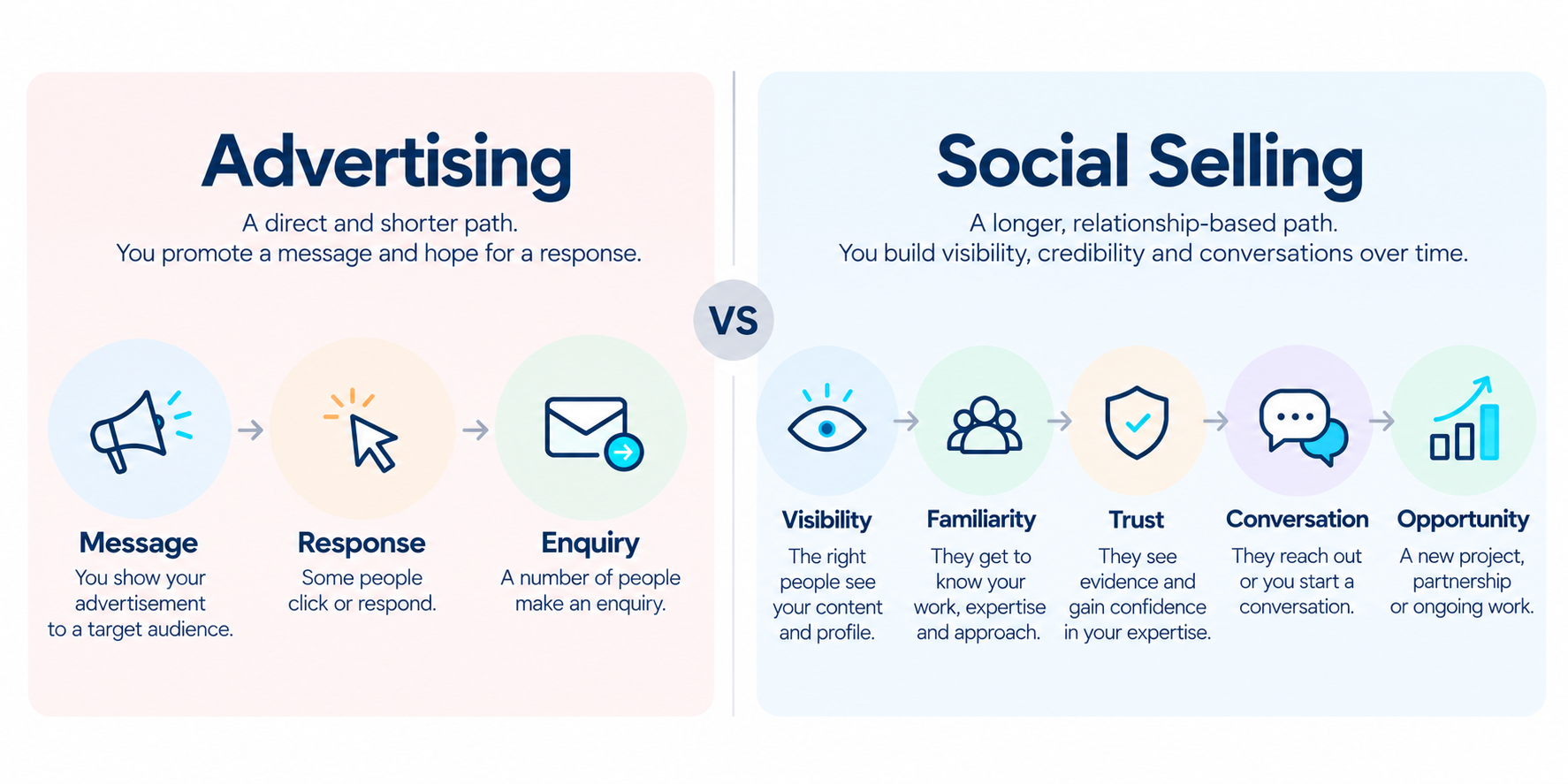
At Peak Profile, we approach B2B social selling as a relationship-building process rather than a sequence of promotional messages. It starts with a credible profile and the right network, then builds familiarity through useful content, strategic engagement and relevant outreach. The goal is to develop those relationships into meaningful conversations and, ultimately, potential business opportunities.
There is no universal timeframe.
The speed at which social selling produces commercial results depends on factors such as your starting network, target market, offer, existing reputation, content, outreach quality, consistency and the length of your sales cycle.
The first few months should not be judged solely by whether a major deal has been won. Instead, look for evidence that the quality of your network and conversations is improving.
A business that already has an established network of relevant decision-makers may generate conversations relatively quickly. A company starting with a limited LinkedIn presence may first need to build credibility and establish the right connections.
It is therefore more useful to think about social selling in stages of progress rather than a single deadline.
| Stage | What you are building | What to look for |
| Visibility | Awareness | Relevant people discovering your business |
| Network | Reach | Connections with target decision-makers |
| Engagement | Familiarity | Meaningful interactions with relevant people |
| Conversation | Relationships | Direct conversations with prospects |
| Opportunity | Commercial interest | Meetings, enquiries and quotation discussions |
| Pipeline | Business development | Active opportunities and potential new accounts |
This provides a more realistic way to assess progress.
If a business has moved from almost no relevant LinkedIn relationships to a network of potential customers who recognise the company and are willing to communicate with it, something valuable has already happened.
The next question is whether those relationships are progressing towards commercial opportunities.
One of the easiest ways to slow down social selling is to build the wrong network.
A large number of connections is not necessarily useful if those people have little relevance to your business.
The audience should be defined by the type of customers and opportunities you want to develop.
Depending on the business, that might include:
The exact audience will vary.
A software company may target technology leaders. An accounting firm may focus on business owners and finance decision-makers. A construction business may target builders, developers, project managers and procurement professionals.
A prospect who receives a connection request may investigate your profile before deciding whether to engage further.
What they find can either reinforce the reason for connecting or create uncertainty.
Your profile should make it relatively easy to understand:
The company page should provide additional evidence and context.
This does not mean turning LinkedIn into a sales brochure. It means making sure that when someone takes the time to investigate your business, the information they find supports the relationship you are trying to build.
For an owner-led business, the personal profile can be particularly important because the relationship is being built between people, while the company page reinforces the organisation behind that person.
A prospect does not necessarily need your service when they first discover you. That is why useful content has a role beyond generating likes or comments.
Content can demonstrate how you think, what you know and the problems you understand. The subject matter should come from the questions your customers actually ask and the situations they encounter.
For example:
A construction business could explain what builders should consider before engaging a scaffolding provider.
An accounting firm could explain common financial issues business owners need to consider before expanding.
A software company could explain how to evaluate whether an integration project is worth pursuing.
The common principle is simple: Show your expertise in a way that helps the people you want to work with.
A project photograph, customer question, industry observation or practical explanation can all contribute to that process when the content provides context and demonstrates genuine knowledge.
Publishing content is only one part of social selling.
If your target customers are active on LinkedIn, paying attention to their activity can create additional opportunities to become familiar with them.
That might mean contributing to a relevant discussion, responding to a post or acknowledging something connected to their business.
The objective is not to comment on everything or manufacture engagement.
It is to participate where there is a genuine reason to contribute.
Over time, these small interactions can make a future direct conversation feel more natural because the prospect is no longer encountering your business for the first time.
After several months of consistent activity, you should ideally be able to see whether the strategy is creating a stronger foundation for business development.
That might include a more relevant professional network, greater visibility among target decision-makers, more meaningful engagement and an increasing number of direct conversations.
For some businesses, this can lead to meetings and enquiries relatively quickly. For others, the sales cycle may mean that opportunities take longer to develop.
A professional services firm may spend months developing a relationship before a client is ready to engage. A construction company may connect with a project manager well before a relevant project reaches procurement. A technology provider may need several conversations before a prospect is ready to evaluate a solution.
This is why a three-to-six-month period should be viewed as a useful evaluation window, not a guarantee that every business will generate a particular number of leads.
The question should be whether the quality and commercial relevance of the relationships are improving.
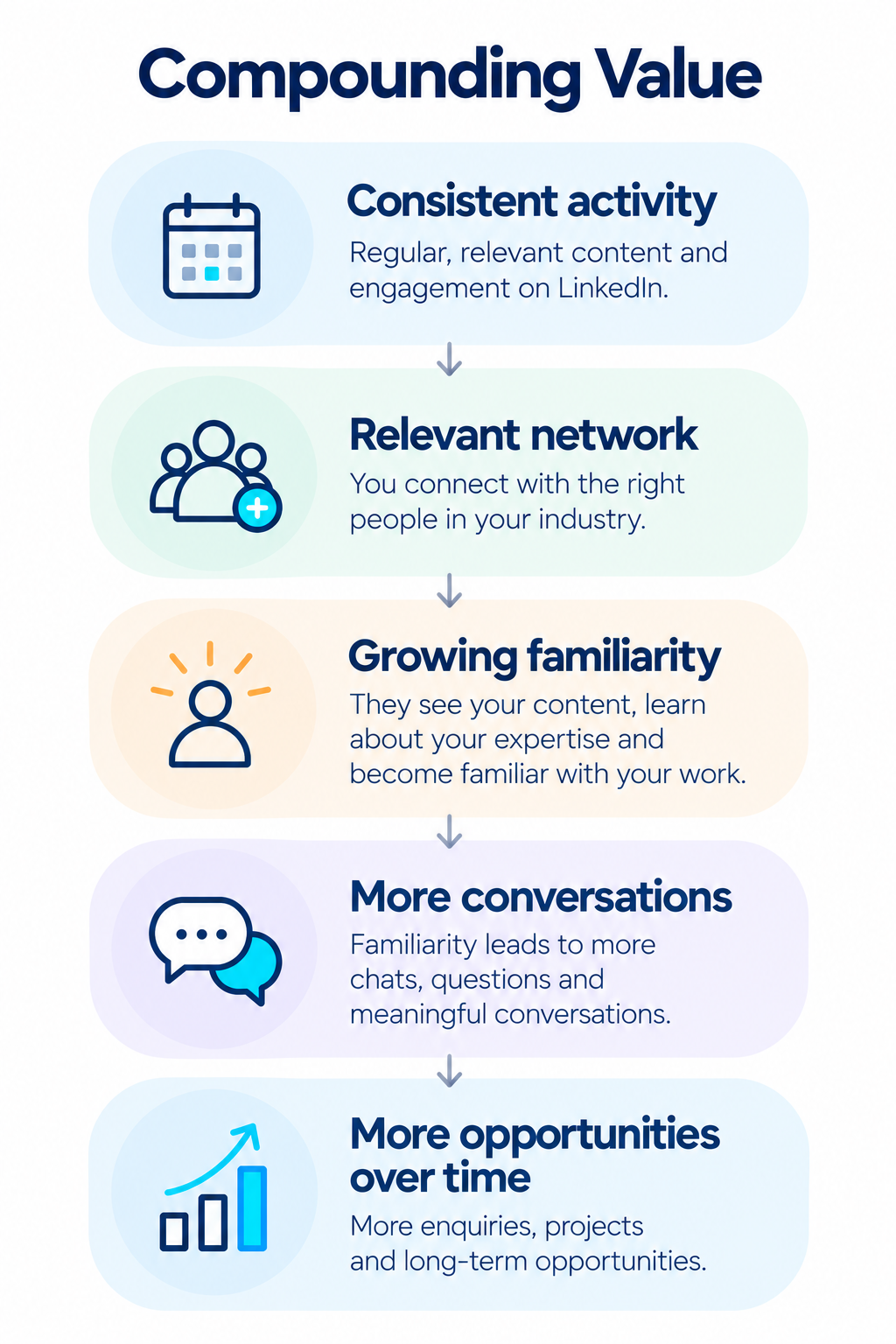
One of the reasons businesses invest in social selling is that the work can continue to provide value beyond the first interaction. This is different from an advertising campaign where the visibility generally depends on continuing to spend.
That does not make social selling “free”. It requires strategy, content, research, outreach, engagement and follow-up.
But the objective is to build an asset of relevant relationships and professional visibility, rather than relying only on individual campaigns.
Follower growth and post reach can provide useful context, but they should not be the primary measure of a B2B social-selling programme.
The more useful measures follow the journey towards commercial results.
| Area | What to measure |
| Network | Relevant decision-makers added |
| Visibility | Profile views and relevant content reach |
| Engagement | Meaningful interactions from target prospects |
| Conversations | Direct conversations started |
| Leads | Qualified prospects and enquiries |
| Opportunities | Meetings, quotations and active opportunities |
| Commercial outcome | New accounts and won business |
The distinction is important because social selling starts producing signals before it produces sales.
A growing number of relevant connections and conversations can indicate that the strategy is moving in the right direction. If months pass without meaningful engagement from the intended audience, however, the answer may not simply be to wait longer.
The strategy may need to change.
A prospect might discover your business today, connect next week, engage with your content several times and contact you six months later.
Another prospect might respond to an outreach message immediately.
Someone else may remain connected for two years before becoming a customer.
All three relationships can be valuable.
This is why social selling should be understood as a process of moving relevant people from unknown to known, from known to familiar, and from familiar to a potential business relationship.
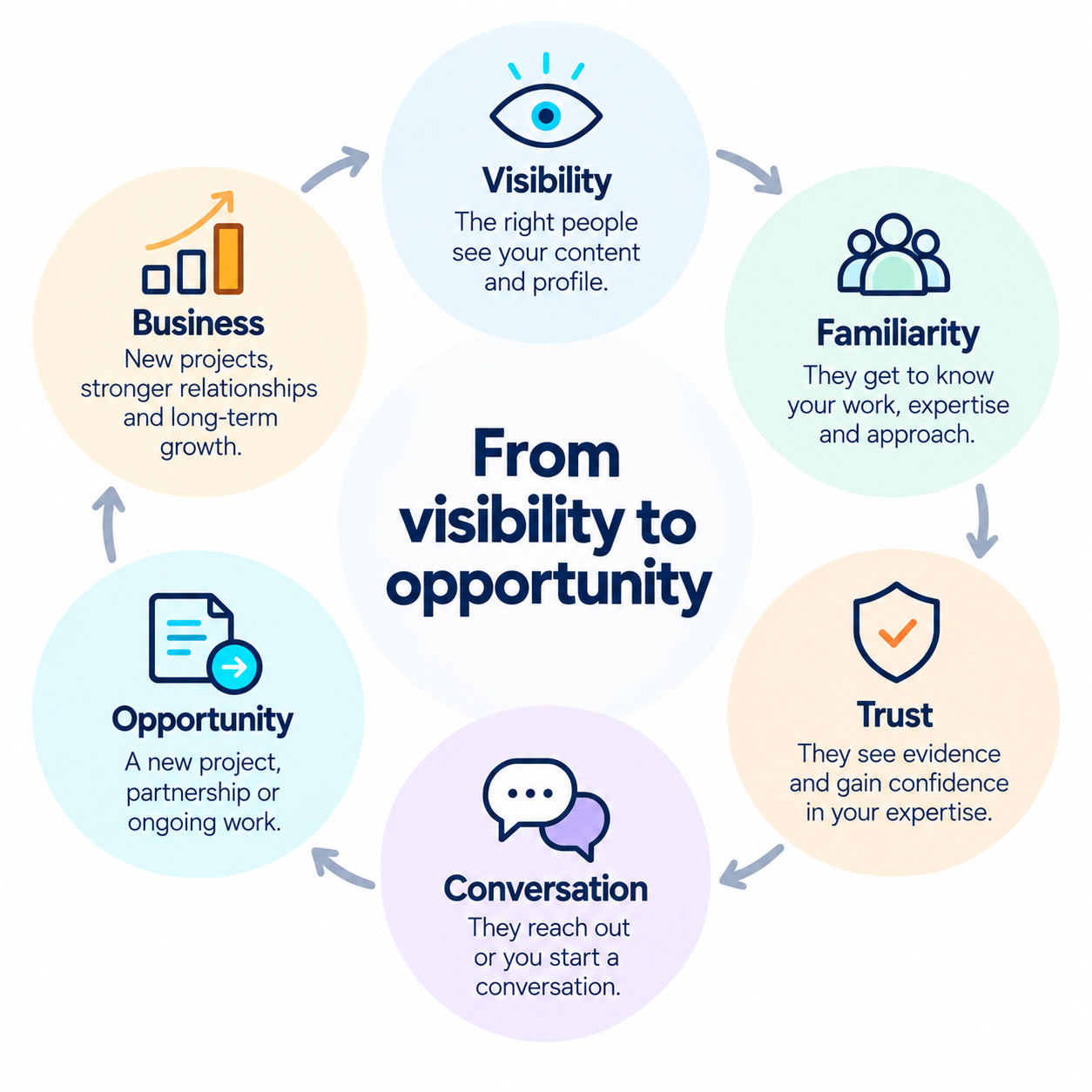
The timeframe will vary.
The progression is what matters.
For businesses that rely heavily on referrals, existing relationships or reactive sales activity, social selling can provide another way to build a future pipeline.
It can be particularly valuable when your potential customers are identifiable professional decision-makers and the buying process depends on trust and relationships.
It is not a replacement for a strong service, a clear offer or an effective sales process.
Nor should it be treated as a shortcut to instant leads.
Its value comes from consistently building visibility and relationships with the people your business actually wants to work with.
If those relationships are developing into relevant conversations and opportunities, social selling is doing its job.
For businesses without an internal marketing team, managing audience research, LinkedIn activity, content, outreach and follow-up alongside day-to-day operations can be difficult.
Peak Profile’s Social Selling & Lead Generation service is designed to bring these activities together around a clear business-development objective.
The approach starts with identifying the right audience and strengthening the business’s professional presence. From there, targeted network building, useful content, engagement, relevant outreach and follow-up work together to create opportunities for meaningful conversations.
The objective is not simply to make a business more active on LinkedIn.
It is to help create a repeatable process for building relevant relationships that can contribute to the sales pipeline.
If you are considering social selling but are not sure whether it fits your business, a discovery call can be a useful starting point.
Discuss your current lead sources, target customers, LinkedIn presence and business-development goals with the Peak Profile team.
There is no fixed timeframe. Some businesses may generate conversations relatively quickly, while others need several months to build the right network and develop relationships. The target audience, sales cycle, existing network, content and outreach approach all influence the timeframe.
It can produce early signals such as relevant connections, profile views, engagement and conversations. However, these should not be confused with guaranteed sales results. The first month is often more useful for establishing the foundations and testing whether the business is reaching the right people.
Give the strategy enough time to build a meaningful network and generate a pattern of interactions rather than judging it after a few posts. A review after the first few months can help determine whether the right audience is being reached and whether activity is progressing towards relevant conversations and opportunities.
Not necessarily. It is most useful where potential customers can be identified through professional roles, companies or industries and where relationships influence purchasing decisions. The suitability depends on the target market and sales model rather than simply whether the business operates in B2B.
No. Targeted outreach can be part of social selling, but it is combined with profile optimisation, content, engagement and relationship-building. The objective is to make outreach more relevant and create a context for conversations rather than relying entirely on cold sales messages.
Measure relevant connections, engagement from target prospects, conversations, qualified leads, meetings, quotations and opportunities. These provide a clearer picture of commercial progress than follower numbers or post volume alone.
Neither is universally better. Paid advertising can create faster visibility and immediate response opportunities, while social selling focuses on developing professional relationships over time. Many B2B businesses can use both, depending on their objectives, audience and sales cycle.
Peak Profile is a Sydney-based digital marketing agency. The team works across social selling, LinkedIn lead generation, content, SEO, paid advertising, email marketing and broader marketing strategy, connecting marketing activity with meaningful business objectives.

 Social Selling & Lead Generation
 Growth Strategy & Peak Scorecard
 Paid Growth & Search Advertising
 Content Marketing
  Email Marketing & Automation
 Search & AI Visibility