September 28 2026
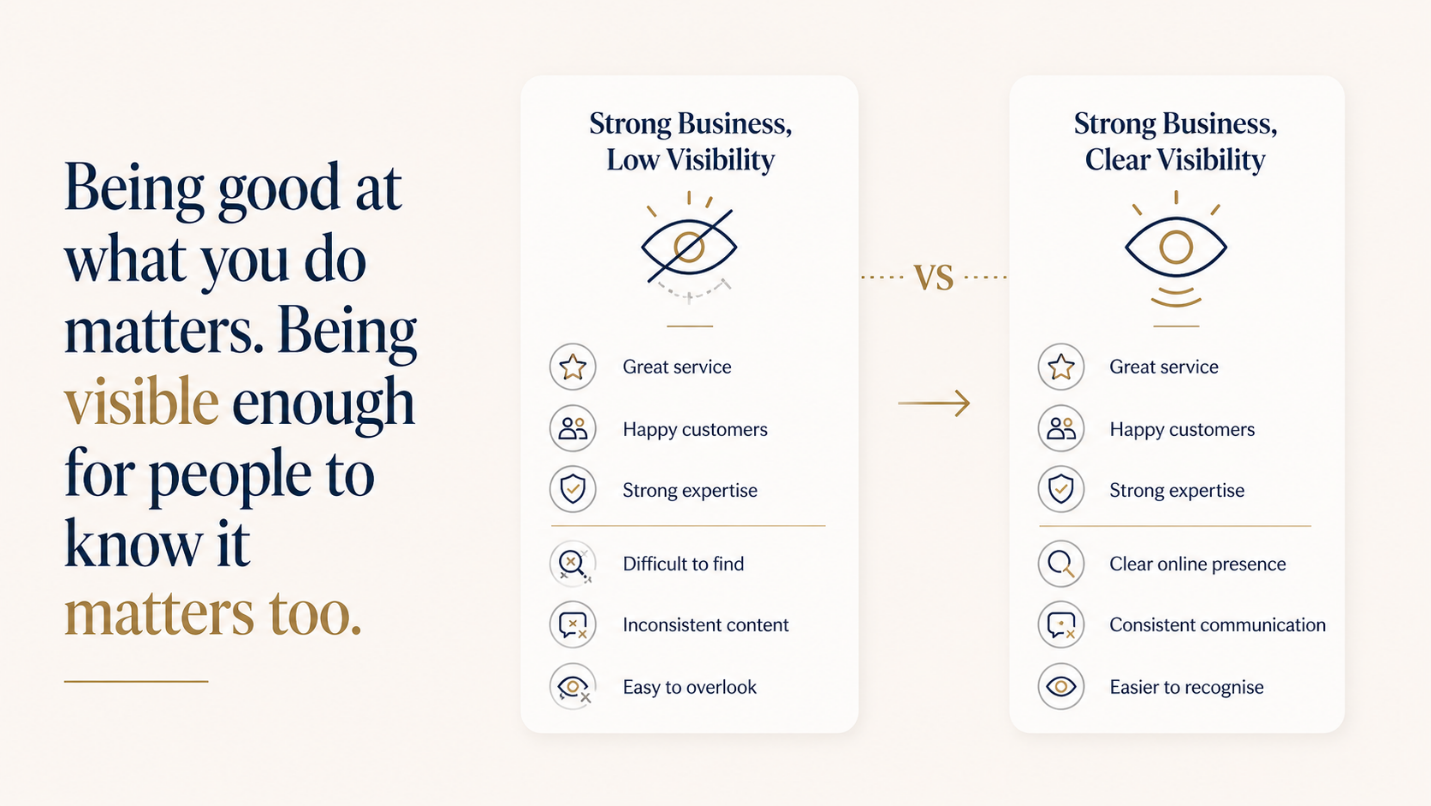
A business can deliver excellent work, have loyal customers and offer a genuinely valuable service, yet still struggle to attract attention online.
The problem is not always the quality of the business. Sometimes, the right people simply do not see it often enough, understand what makes it different or remember it when they are ready to make a decision.
That creates a frustrating situation. A competitor may appear more established, not because they offer a better service, but because they communicate more consistently and make their value easier to understand.
Building online visibility does not mean becoming an internet celebrity or chasing thousands of followers. For most small businesses, the objective is much simpler:
Be visible to the right people, communicate your value clearly and stay familiar enough to be considered when a need appears.
Customers often research a business before they make contact. They may visit the website, look at LinkedIn, review social media profiles or search for evidence that the company has relevant experience.
What they find helps shape their first impression.
If the business has not posted for months, its profiles are unclear or its content does not explain what it actually does, potential customers may struggle to recognise its value.
Meanwhile, a competitor that communicates consistently can appear larger, more active or more established simply because it is easier to find and understand.
The objective is therefore not to reach everyone.
It is to become recognisable to the people who matter to the business.
Publishing content keeps a profile active.
Marketing gives that content a reason to exist.
A business can post several times a week and still struggle to create meaningful results if the content is disconnected from its audience or business goals.
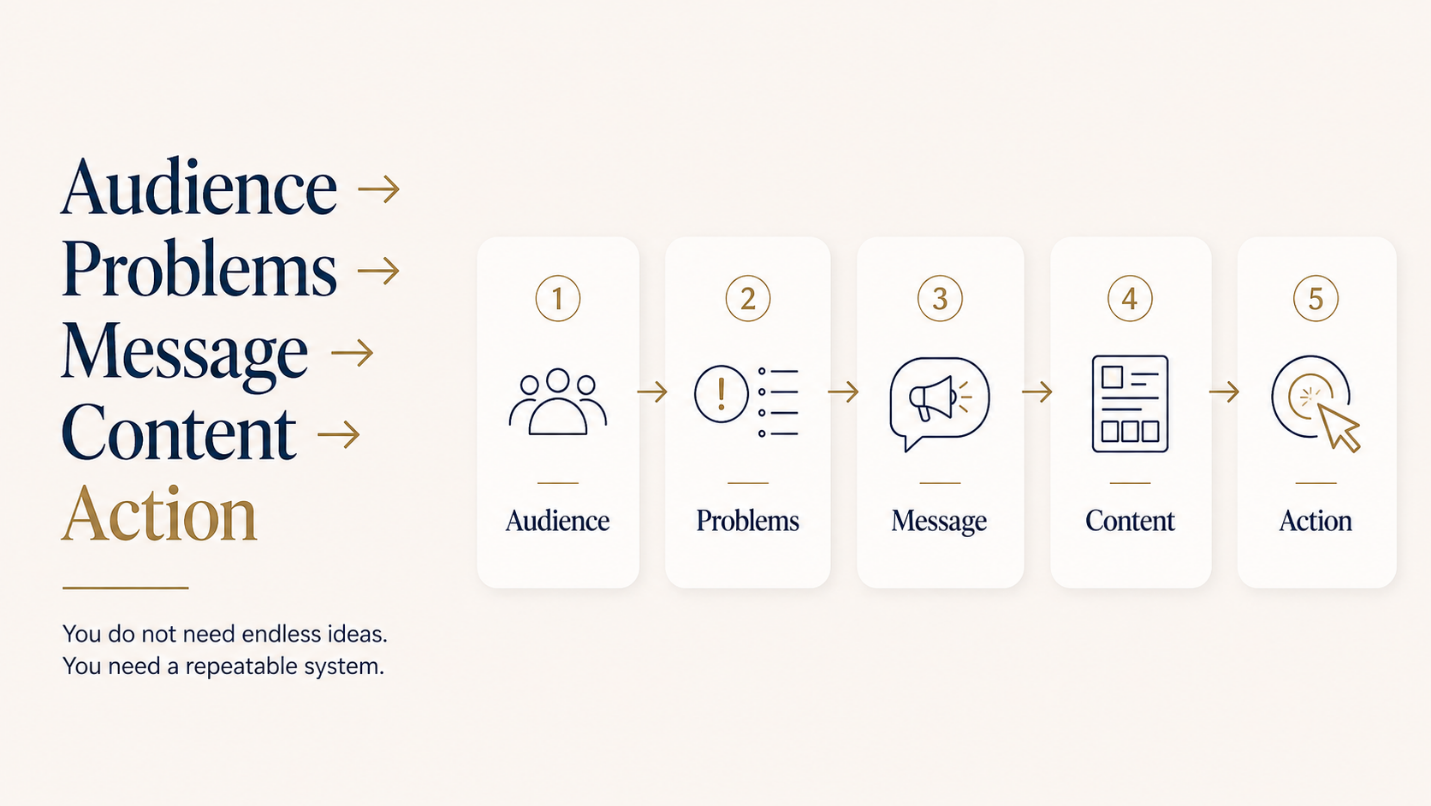
Marketing starts with a different set of questions:
That difference changes the role of content.
| Posting | Marketing |
|---|---|
| Focuses on keeping the feed active | Focuses on a business objective |
| Starts with “What should we post?” | Starts with “What are we trying to achieve?” |
| Can be reactive | Follows a strategy |
| Treats posts individually | Builds a connected message |
| Measures activity | Measures useful outcomes |
A strong marketing strategy allows different types of content to work together. Educational posts can demonstrate expertise, case studies can provide proof, problem-solution posts can show relevance, and conversion content can give an interested prospect a clear next step.
One of the most common problems businesses face is:
“We don’t know what to post.”
Most of the time, that is not a creativity problem.
It is a strategy gap.
When there is no clear direction, every month starts with a blank page. Ideas are chosen at the last minute, messaging becomes inconsistent and content depends too heavily on inspiration.
A content system changes that by establishing what the business should communicate regularly.
A practical strategy should define:
From there, content can be organised into clear categories.
| Content type | Purpose | Examples |
|---|---|---|
| Authority | Build credibility | Industry insights, expert opinions |
| Problem-Solution | Show relevance | Customer challenges and solutions |
| Proof | Reduce uncertainty | Case studies, testimonials, results |
| Educational | Demonstrate expertise | Guides, tips, FAQs |
| Conversion | Encourage action | Audits, consultations, resources |
This means the business is no longer inventing its marketing from scratch every month.
The ideas already exist inside the company. Customer questions, industry knowledge, lessons learned, case studies and everyday experience can all become useful content when there is a structure for capturing and developing them.
Businesses often create unnecessary work by treating every idea as a one-time post.
A useful insight may appear once on LinkedIn and then disappear, even though the same idea could support several pieces of marketing.
For example, one customer question could become:
This is not about copying the same post across every channel.
It is about adapting one useful idea to different formats and stages of the customer journey.
A blog article can explain the subject in detail. A social post can introduce one key point. A carousel can simplify it visually. A salesperson can use the article later when a prospect asks the same question.
This approach makes content easier to manage while also creating more value from the expertise already inside the business.
Content can attract attention, but the profile or website someone visits afterwards needs to make the next step easy.
A strong profile should answer three questions quickly.
Visitors should immediately understand whether the business is relevant to them.
Your profile should demonstrate credibility through clear positioning, experience, services, results, testimonials or case studies.
Interested visitors should not have to search for the next action.
That action could be:
This is where many businesses lose potential opportunities. Their content generates interest, but the profile does not explain the offer clearly enough or direct the visitor anywhere.
Follower numbers are easy to compare, but they do not tell you whether the audience is commercially useful.
A business with 20,000 followers may still struggle to generate meaningful enquiries if those followers are disconnected from its target market.
Another company may have a much smaller audience made up of business owners, buyers or decision-makers who are directly relevant to its services.
That smaller audience may be far more valuable.
| Metric | Better question |
|---|---|
| Followers | Are they relevant to our business? |
| Likes | Are the right people engaging? |
| Reach | Are we visible in our target market? |
| Connections | Are they potential customers or useful relationships? |
| Website traffic | Are visitors taking the next step? |
| Enquiries | Are they relevant and qualified? |
Follower growth, engagement and reach still provide useful information.
They simply need to be viewed in the context of the business objective.
The goal is not to build the largest audience.
It is to build the right audience.
Marketing and sales should not be treated as separate activities.
Marketing helps people discover the business, understand its expertise and become familiar with its message.
Sales turns that familiarity into a direct relationship.
This is especially important for B2B and professional services, where potential customers often research possible providers before initiating a conversation.
A potential customer may first discover the company through a post.
Later, they see an industry insight.
They visit the profile and understand the services.
Then they notice a case study.
By the time a requirement appears, the business no longer feels completely unfamiliar.
Marketing has not closed the deal.
It has made the sales conversation easier to begin.
A business can be active online and still be difficult to understand or remember.
Your profile may not communicate the offer clearly. Your content may be useful but too broad. The right audience may not be seeing it, or interested visitors may not know what to do next.
Publishing more content does not necessarily solve those issues.
Understanding the gaps is the better starting point.
Peak Profile can review your current online presence and identify opportunities across areas such as:
The goal is to give your business a clearer picture of what is working, what may be holding your marketing back and what should be prioritised next.
Find out where your business may be losing visibility, trust or opportunities — and what to improve first.
Why is online visibility important for a small business?
Visibility helps potential customers discover, research and remember a business. It also creates more opportunities to demonstrate expertise and communicate value before the customer is ready to make contact.
Do I need to post every day?
No. The right frequency depends on the business and platform. Consistency and relevance are more important than publishing every day simply to remain active.
Why am I posting regularly but not getting enquiries?
Posting frequency alone does not create enquiries. The problem may be unclear messaging, the wrong audience, weak positioning, insufficient proof or the absence of a clear call to action.
Do follower numbers matter?
They provide context, but relevance matters more. A smaller audience containing potential customers and relevant decision-makers may be far more valuable than a large but disconnected following.
What should a strong social media profile include?
It should clearly communicate who you help, what you offer, why the business is credible and what the visitor should do next.
Can social media generate clients?
Yes, when it is connected to a wider marketing and sales strategy. Social media can build visibility, credibility and familiarity, making enquiries and sales conversations easier to generate.
What is the difference between posting and marketing?
Posting is the act of publishing content. Marketing connects that content to a specific audience, message, purpose and business goal.

 Social Media Management
 Social Media Strategy Planning
 Social Media Setup & Branding
 Content Creation & Publishing
 Email Marketing
 Search Engine Optimization (SEO)
 Pay-per-click (PPC) Advertising