September 29 2026
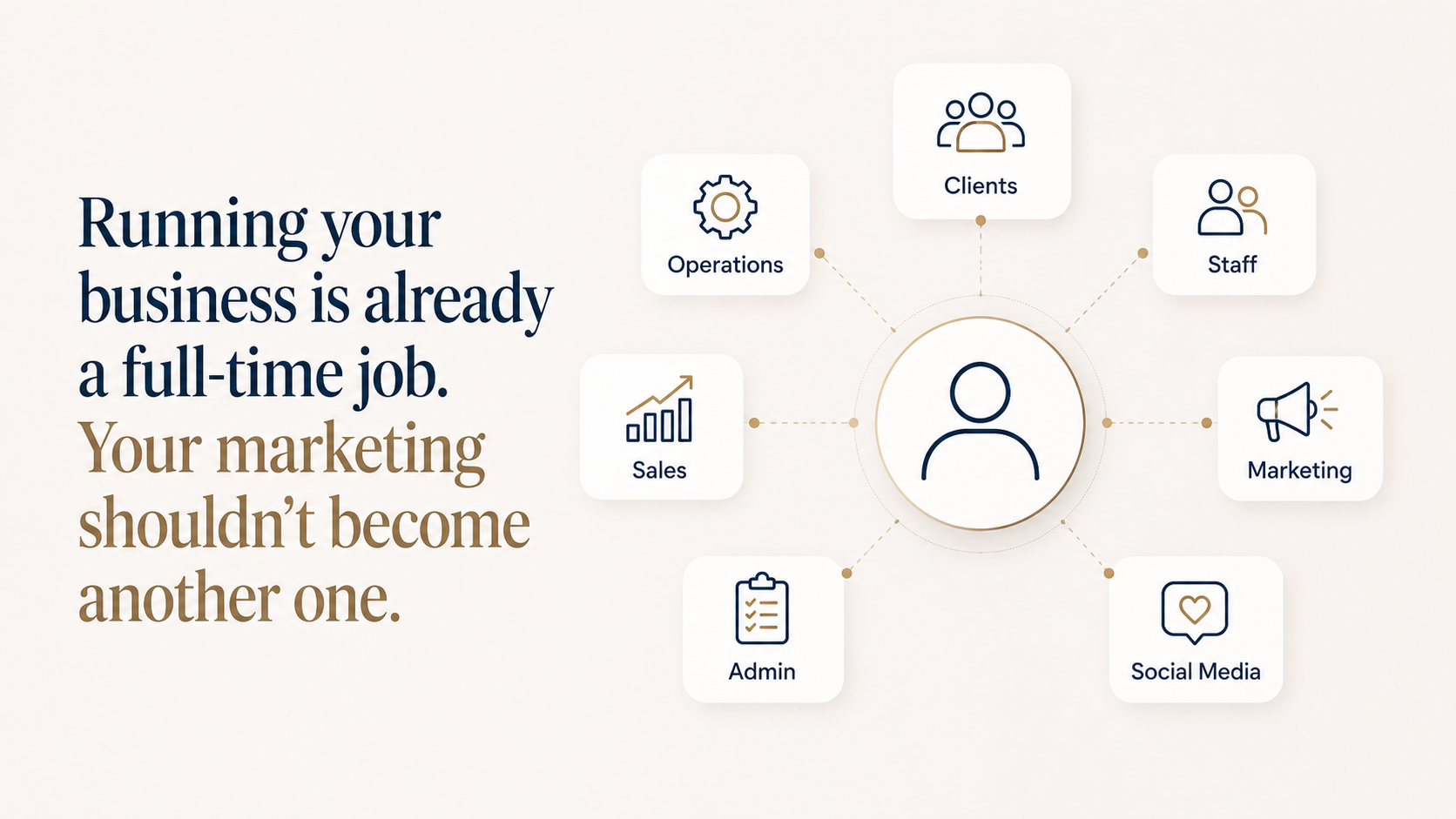
Running a small business means your attention is constantly divided between customers, operations, sales, staff, administration and growth. Marketing matters, but it often becomes another responsibility competing with work that feels more immediate.
Most business owners already understand that they need to stay visible online. The challenge is finding enough time to decide what to say, create content, design graphics, publish consistently, engage with the audience and understand whether the activity is actually contributing to the business.
Managed social media can reduce that pressure by creating a more organised way to plan, produce and manage marketing activity. Instead of starting from scratch every week, the business works from an agreed direction and a repeatable process.
The goal is not simply to publish more posts. It is to help the business stay visible, build credibility and create opportunities without requiring the owner or team to personally manage every marketing task.
One of the biggest misconceptions about social media is that it only takes a few minutes to manage. Publishing a post may be quick. Everything required to prepare, manage and evaluate that post takes considerably longer.
Someone still needs to:
For many small businesses, those responsibilities do not sit with a dedicated marketing team. They are added to the workload of the owner, a salesperson, an administrator or another team member whose main responsibilities lie elsewhere.
As the business becomes busier, marketing is usually one of the first activities to be delayed. One missed post becomes a missed week, content becomes reactive and the business starts publishing only when someone finds enough time. The problem is therefore not simply a lack of content. It is the absence of a reliable process that allows marketing to continue when the business is busy.
The cost of managing social media internally is not only financial. There is also an opportunity cost. Every hour spent researching topics, writing captions or deciding what to post is an hour that could potentially be spent supporting customers, developing services, managing staff, following up opportunities or improving operations.
Internal social media management can still work well when a business has the right expertise, time and resources. The difficulty begins when marketing is treated as an additional task rather than a defined responsibility. That is when the process becomes inconsistent, last-minute and difficult to measure.
Before deciding what to post or which platform to use, the business needs to understand what marketing is expected to contribute. The right objective will vary. A business may want to increase visibility within a particular market, strengthen credibility, explain a complex service, reach new decision-makers, generate enquiries or support an existing sales process.
Once that objective is clear, the rest of the marketing decisions become easier. A business trying to establish expertise may need educational content, industry insights and case studies. A business trying to generate conversations may need stronger problem-solution content, client proof and clearer calls to action.
| Step | Question |
|---|---|
| Business Goal | What are we trying to achieve? |
| Audience | Who needs to see us? |
| Message | What do they need to understand? |
| Content | What will help build interest and trust? |
| Platform | Where should that communication happen? |
| Action | What should the audience do next? |
Rather than treating content, platforms and messaging as separate decisions, this sequence creates one clear path from the business objective to the action the audience should take. It also reduces repeated decision-making and makes the monthly content process easier to manage.
Trying to maintain every social media platform can create unnecessary work for a small business. LinkedIn, Instagram and Facebook are tools. The decision about which ones to use should follow the audience and the business objective.
| Business type | Possible priority | Primary role |
|---|---|---|
| Professional services | Credibility, expertise and professional relationships | |
| B2B businesses | Decision-maker visibility and business conversations | |
| Retail / visual businesses | Product discovery and visual storytelling | |
| Local businesses | Facebook / Instagram | Local awareness and customer communication |
These are starting points rather than fixed rules. A professional services business may prioritise LinkedIn because potential clients often need to understand the expertise behind the service before making contact. A retailer may rely more heavily on visual channels, while a local business may use several platforms to remain visible within its community.
Once the objectives, audience and platforms are clear, social media becomes much easier to manage because the business no longer needs to make the same decisions every week. A managed process can be organised into five practical stages.
The first stage is to understand the company, its customers, competitors, industry and current online presence. This provides the context needed to decide what the business should communicate and where the strongest opportunities may exist.
Topics, messaging and content types are organised in advance through a content calendar. This removes the pressure of continually asking, “What should we post this week?” and helps ensure that different posts work together rather than appearing as unrelated pieces of content.
Business knowledge is turned into professional copy and visuals. The client still contributes the expertise, experiences, opinions and customer insights that make the content valuable, but does not need to personally handle every stage of production.
Content is scheduled consistently on the platforms that support the business goal. Relevant engagement can then help extend visibility and create conversations around the content.
Results are reviewed so future activity can be adjusted based on what is generating useful attention, engagement, conversations and opportunities.
Once the full process is visible, it becomes easier for a business to decide whether it has the capacity to manage social media internally. There is no universal right answer.
Most business owners are capable of publishing a social media post. The more important question is whether personally coordinating the full marketing process is the best use of their time.
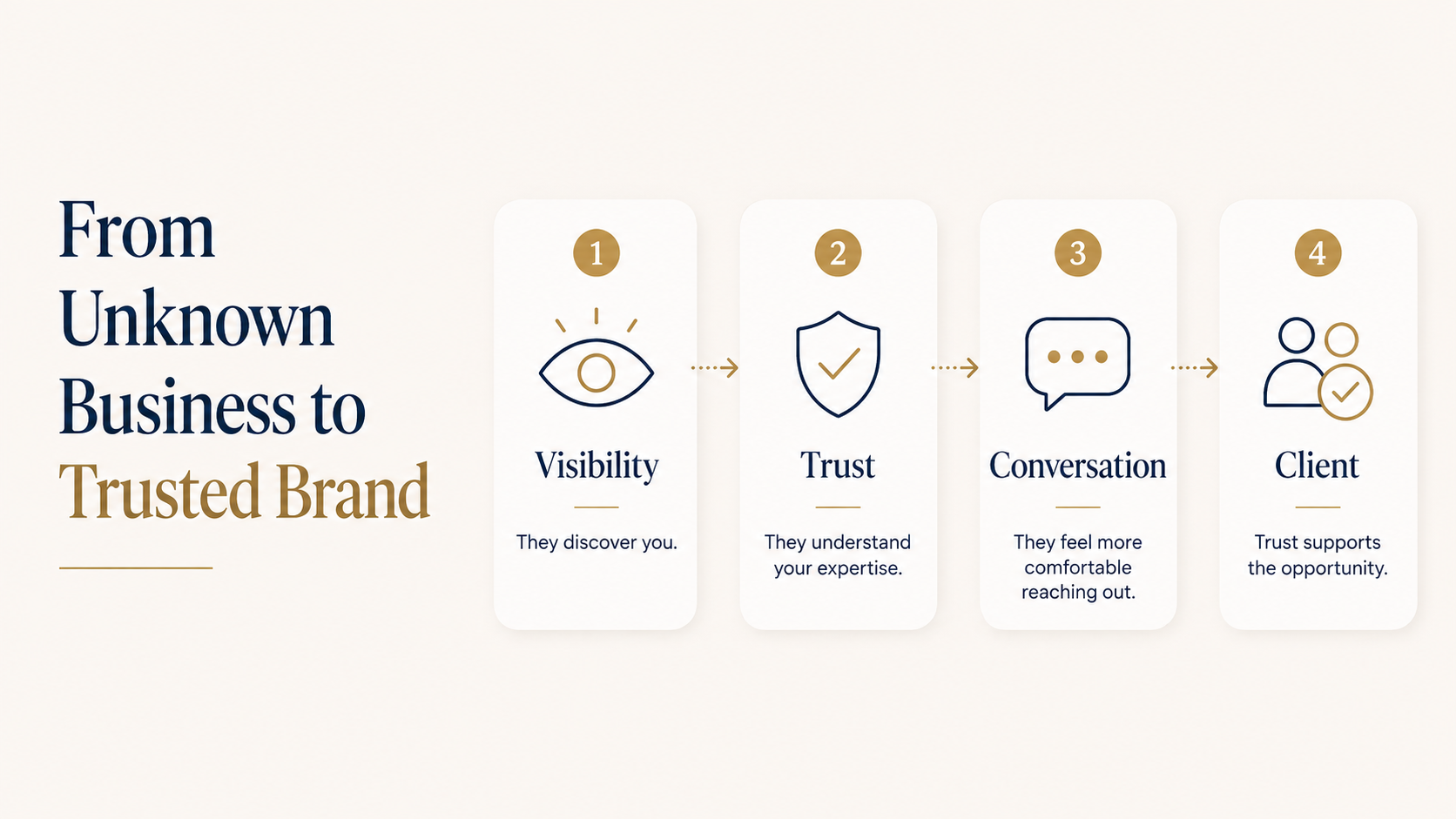
Saving time is one benefit of managed social media, but the wider purpose is to create a stronger path between marketing activity and business opportunities. Potential customers rarely move directly from discovering a company to becoming a client. There is usually a progression.
The potential customer first discovers the business and begins to understand what it offers.
Repeated exposure to useful content, expertise, case studies and insights helps the audience understand why the business may be credible.
When a need arises, contacting the business becomes easier because the company is already familiar.
The trust and familiarity built earlier can support the buying decision and help sales develop the opportunity.
This gives social media a clearer role. It is not simply there to keep profiles active. Its job is to help the right people discover the business, understand its expertise and feel more confident taking the next step.
Once the purpose of social media is clear, measurement becomes more useful. There is no single metric that defines success for every company.
A professional services business may prioritise decision-maker visibility, profile activity, enquiries and qualified conversations. A local business may care more about reach, website visits and local enquiries. A B2B business using LinkedIn to support sales may look at replies, meetings, leads and opportunities.
That is why likes or follower numbers should not be viewed in isolation. A smaller audience made up of relevant potential customers may have significantly more business value than a large audience with little connection to the company.
| Marketing objective | Useful indicators |
|---|---|
| Visibility | Reach, impressions, profile views |
| Credibility | Engagement, content interactions, repeat visibility |
| Traffic | Website visits, landing-page activity |
| Conversation | Messages, replies, enquiries |
| Lead generation | Qualified leads, meetings, opportunities |
| Business growth | Pipeline and attributed customers |
The useful question is not simply, “Did this post perform well?” It is, “Is our social media helping us move toward the business outcome we originally set?”
When social media is not producing the expected results, creating more content is not always the answer. The issue may be unclear messaging, an incomplete profile, inconsistent activity, the wrong audience, unsuitable platforms or a lack of clear next steps for interested prospects.
The better starting point is identifying where the gaps are.
A Peak Profile audit can review areas such as:
The purpose is to help the business understand what is already working, what needs improvement and what should be prioritised next.
Is social media management worth it for a small business?
It can be particularly useful when the business does not have enough time, capacity or internal marketing expertise to manage social media consistently. The value comes from creating a more organised process while allowing the internal team to focus on its main responsibilities.
How much time can managed social media save?
The amount varies according to the number of platforms, volume of content and level of client involvement. Time is mainly saved across research, planning, writing, design, scheduling, engagement and reporting.
How often should a small business post?
There is no universal frequency. A realistic and consistent schedule based on useful content is more important than posting frequently without a clear reason.
Does my business need to be active on every social media platform?
No. Platforms should be selected according to the audience and the role they can play in supporting the business objective.
How long does social media marketing take to work?
Social media usually creates value progressively. Visibility and familiarity develop first, followed by trust, conversations and potential opportunities. The timeline depends on the market, audience, buying cycle and consistency of activity.
What should a small business measure?
Measurement should follow the original business objective. Relevant indicators may include reach, engagement, profile activity, website visits, enquiries, qualified conversations, leads and sales opportunities.

 Social Media Management
 Social Media Strategy Planning
 Social Media Setup & Branding
 Content Creation & Publishing
 Email Marketing
 Search Engine Optimization (SEO)
 Pay-per-click (PPC) Advertising